MOVE ME EGYPT SERVICES
Factory and industrial-site moving
Industrial relocation begins with the equipment list, weight data and movement route, not the number of rooms. We review both sites and identify which physical-moving tasks can be accepted. The factory technical team and production safety lead remain central to the plan, especially around fixed machinery and production lines.
Define the machinery scope before the vehicle
Moving a workshop inventory differs from relocating a fixed production line. For every machine, provide an asset identifier, dimensions, weight from a reliable source, condition and manufacturer-approved handling information. Visual estimates and the fact that a machine rolls inside the factory do not establish transport suitability.
Separate transport-ready items from equipment requiring utility isolation, supplier dismantling or a specialist lift plan. Fixed foundations, tanks and hazardous materials are not treated as office furniture. Acceptance is conditional on the site survey and technical review of each relevant load and route.
Technical isolation comes before physical movement
The client's safety lead and competent technicians determine isolation of electrical, pressure, heat and fluid hazards and release equipment for handling. An off switch is not evidence that all stored energy has been removed. The handover must identify the equipment's state, remaining hazards and movement restrictions.
Technical dismantling, calibration, foundation changes, reconnection and production-line commissioning are not automatically included. Where outside specialists are required, agree their roles and handover times before the transport stage. The moving team should not be asked to discover an isolation problem after handling has started.
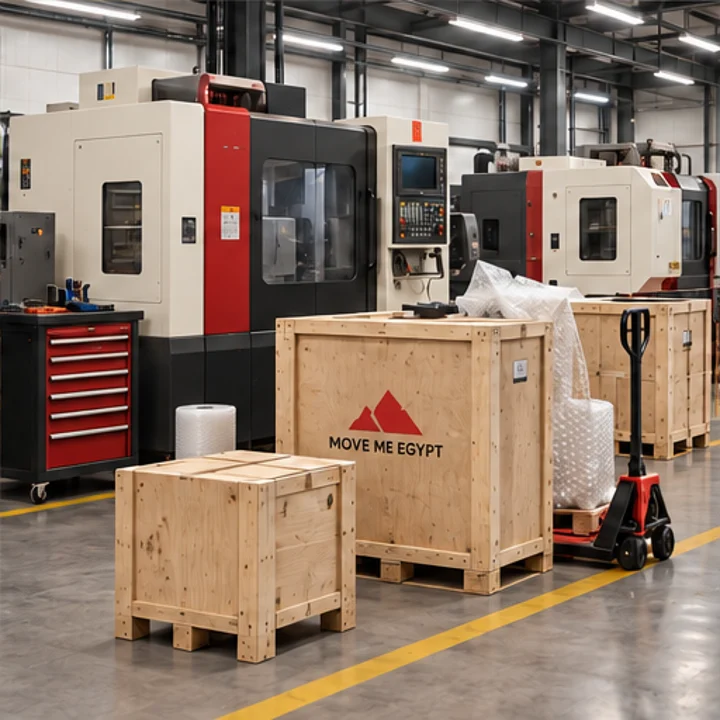
Assess the complete route and load support
Review doors, overhead clearance, corners, thresholds, ramps and floor condition along the entire path. Capacity of floors, lifts and loading positions must be established through the responsible competent party. A route used by people or light furniture is not proof that it supports industrial equipment.
Unusual lifting needs a suitable plan by a competent specialist, covering load characteristics, lifting points, equipment, accessories and exclusion areas. Not every machine can use the same crane or loading method. The selection must reflect actual weight, stability, geometry and conditions, not an optimistic estimate.
Protection, labels and component control
Protect machined surfaces, control panels and projecting parts in line with manufacturer guidance. Do not hide lifting points or identification needed during handling. Remove only components approved for removal, and connect every loose item to its machine number and an authorised reference record.
Group crates by installation area at the destination. Tools, spares, raw materials and fluids need separate identification; unknown substances must not be mixed into machinery packages. Disclose cleanliness, moisture or dust sensitivities before choosing protection or temporary storage. Packing choices must fit the equipment, not merely fill available vehicle space.
Plan shutdown through to technical recommissioning
Link production shutdown, isolation, packing, exit, delivery and reinstallation as separate dependencies. Equipment arrival is not the same as production restart. Allow approval time between stages, and consider whether non-critical stock can move earlier without obstructing safe routes.
At arrival, reconcile assets, loose parts, packaging condition and the agreed delivery positions. The client's representative accepts physical receipt; specialists then handle anchoring, alignment, utilities and tests. Changes in weights, quantities or access require reassessment rather than being treated as a small automatic addition on moving day.
The four equipment classes, and how each one travels
A factory is not one load but four. The survey sorts everything on your floor into classes, because each class has its own handling rules, its own paperwork and its own place in the sequence.
Machine tools and production lines
Lathes, mills, CNC centers, presses, injection molders and the lines they form are the heavy, precise heart of the move. They travel stripped of their loose tooling, with axes locked, heads secured and fluids drained where the maker requires it. Each machine gets its own rigging plan: lift points, center of gravity, skid or crate, and the order in which it leaves the floor, because a line is a chain and the chain leaves link by link, never all at once. Recommissioning notes travel with each machine so the technicians at the new site read the same story the survey wrote.
Support equipment
Compressors, boilers, chillers, transformers, dust extraction and air handling keep production alive but answer to utility rules more than rigging rules. They are disconnected by licensed technicians, capped, tagged and tested before we lift them, and reconnected at the new site in the order the startup sequence needs. Their condition is documented jointly before disconnection, so there is no argument later about what worked before the move.
Raw material, work in progress and finished stock
Materials travel by their own logic: palletized, wrapped, labeled to the new layout, and sequenced so production can restart from the first pallet rather than the last. Stock that is heavy, hazardous or temperature-sensitive is flagged at the survey and given its own plan, and anything your insurers or regulators treat specially is named plainly in the inventory rather than discovered on moving day.
Offices, labs and the small world around the machines
Every factory hides an office, often a lab, sometimes a server room, and always a thousand small things without which the first week stalls: hand tools, spare parts cabinets, gauges, safety equipment, files and samples. These are packed and labeled with the same discipline as the machines, because a factory that has its press but not its calibrated gauges has not really moved.
Rigging, access and the physics of the floor
Before anything moves, the survey answers the questions the building asks. What does the floor carry per square meter, on both sites and on every level between the machine and the truck? Which doors, docks, yards and lifts admit which machines, and which need a wall opened, a window removed or a crane pick over the roof? Where does the crane stand, and does the ground under its outriggers hold? These are measured, not guessed, because a machine that cannot leave the building is not a moving problem but a demolition problem, and it is far cheaper to learn that at the survey than on the day.
Heavy lifting on factory moves is its own trade. Our crews work with certified rigging gear, spreader bars, skates, jacks and, where the building demands it, crane lifts, including high-level picks where equipment must enter or leave above ground floor. Every lift above a threshold weight has a written lift plan: the machine, the gear, the people, the exclusion zone and the weather limit. Forklifts are matched to load and aisle, never simply the nearest truck on the yard. Where a machine must travel on its skates through your own production floor, we protect the slab and the machines that stay behind, because the factory you keep matters as much as the one being moved.
The downtime window is the real budget
A factory move is paid for twice: once in the quote and once in the days the line stands still. The second figure dwarfs the first, and it is the one the plan is built around. The survey starts from your production calendar: which lines can stop first, which orders must ship before the move, which customers cannot be late. From there the sequence runs backward to a moving window, often nights, weekends or a planned maintenance stop, so the hours we spend on the floor are hours the factory had already given up.
Where the two sites must overlap, we plan the overlap: what runs at the old address until which day, what is commissioned first at the new one, and which machine is the bridge that lets one site wind down while the other winds up. A phased move, line by line, often beats a single big bang for exactly this reason: production never fully stops, it simply moves address over a week. The honest number we give you at the end of the survey is not only a price; it is a date, the day your line runs again at the new address, and every decision in the plan defends that date.
Disconnection and recommissioning: who does what
The boundary is drawn plainly at the survey and written into the plan: licensed technicians disconnect and reconnect everything that is wired, piped, gassed or pressurized, and our crews handle everything that is lifted, carried, packed and driven. Neither side crosses the line, because insurance, warranty and safety all live exactly on it. A machine that leaves the floor properly isolated, capped, tagged and documented arrives as a machine; one that was yanked off its feeds arrives as scrap with a story.
Precision equipment adds a third player: calibration. Machines with metrology duties, lab instruments and any equipment your quality system tracks are documented before disconnection and verified after recommissioning, with the certificates filed where your auditors expect to find them. If your line answers to a quality standard, tell us at the survey and the calibration visits join the same sequence as the lifts. The goal at the new address is never merely a machine standing in position; it is a machine back in tolerance, in service, and in your records, with a dated handover that says who verified what and when.
Insurance and liability, stated honestly
Heavy equipment concentrates risk in a way household goods never do: one dropped spindle can cost more than an entire house move. That is why the survey does not stop at counting machines but values them, with you, line by line, and writes the declared values on the inventory before anyone lifts anything. Equipment we rig, pack and carry travels under our full insurance frame, up to those declared values. Damage by third parties, faults that existed before the move and the work of your own or the maker's technicians sit outside it, and we say that at the survey, in writing, rather than let anyone discover it in a claim.
There are practical consequences worth knowing. Undeclared value is uninsured value, so the fifteen minutes spent walking the floor with honest numbers is the cheapest insurance you will ever buy. Machines under warranty or service contract may need the maker's own technicians for parts of the work, and we plan around their visits rather than pretend they do not exist. And because photos settle arguments before they start, condition is documented jointly, machine by machine, before disconnection. None of this is fine print; it is the shape of a move where everyone knows exactly where they stand before the first bolt is loosened.
People, permits and the neighbor problem
A factory move touches more people than it employs. Your own team needs to know the sequence early: which lines stop when, who packs their own benches, who escorts which load, and which days they simply stay home because a crane over the roof and a full workforce are a bad combination. Drivers, guards and landlords at both addresses need the schedule; industrial zones and business parks need gate passes booked in advance; and a crane pick on a public street needs its permits arranged before the crane is booked, not after. None of this is glamorous, and all of it is in the plan, because the fastest lift is the one nobody is standing in the way of.
Then there are the neighbors. A day of rigging is loud, and a courteous notice to the units around both sites, with the hours and a contact number, turns complaints into patience. If your move crosses cities, the convoy plan covers routing, timing and rest stops the same way our long-distance household moves do, scaled for heavier axles and wider loads. Communication is a workstream like rigging is a workstream, and it has an owner, a schedule and a checklist like any other.
The mistakes that keep factories dark for an extra month
The same handful of errors account for most factory moves that run long. Moving before the new site is truly ready is the classic: the floor is painted but the power is not connected, the gate pass is unbooked, the extraction ducting arrives next month, and the machines sit in crates while rent is paid on two addresses. The cure is the readiness checklist, run honestly, with the move date sliding only when a real item on it is red, and someone with authority allowed to say so. A close second is under-declaring values to save on the premium, which converts a modest saving into an uninsured catastrophe the first time a crate tips. Third is letting the move and the recommissioning be planned by different people who never meet, so the riggers place machines where the electricians cannot reach them and the whole floor has to be picked up twice.
There are quieter mistakes too. Forgetting that work in progress is also a load, so half-finished orders are discovered on the last day with no plan and no packaging. Letting every department pack its own way, so the crates at the new site speak four labeling languages and nothing can be found. Announcing the reopening date to customers before the survey exists, turning a plan into a hostage. And skipping the joint condition documentation to save an afternoon, then spending a month arguing about a scratch. Every one of these is free to avoid; each is expensive to live through. The checklist below exists so none of them survives contact with your move.
The owner's checklist, four weeks out
Four weeks before the move, the survey should be done, the inventory valued, the technicians booked and the new site's readiness list started. Confirm the dates that do not move: lease ends, customer commitments, booked crane windows. Three weeks out, freeze the layout of the new floor and start running raw material down toward the plan, because every pallet you do not have to move is profit. Two weeks out, hold the joint condition documentation days, machine by machine, and brief your team on the sequence and their part in it. One week out, confirm gate passes, permits, parking, guard schedules and the neighbors' notices at both addresses, and run the readiness list one final time with the authority to delay present in the room.
During the move itself, your job shrinks to three things: be reachable, sign what the day produces, and resist the urge to re-plan in the middle of a lift. After the move, walk the new floor against the inventory before you sign the handover, keep every document in one folder, and schedule the first maintenance round early, because machines that survived the road still appreciate attention after it. And when the line runs again, tell us; the handover is not complete in our books until production is.
Why factories move with MOVE ME EGYPT
Because we plan the restart, not just the ride. Every chapter of this page is a promise we put in writing at the survey: the valued inventory, the lift plans, the technicians' boundary, the downtime window defended like a budget, the readiness checklist with honest red flags. Because our crews rig heavy equipment for a living, with certified gear, written lift plans and cranes where the building demands them. Because the quote is itemized and the insurance terms are said out loud before the first bolt turns. MOVE ME EGYPT, the moving brand of INEX LOGISTIC, around the clock, every governorate, for the week your factory changes address and the day your line runs as if it never stopped.
Phased moves, single machines and everything between
Not every factory move is a whole factory. The commonest small version is the single machine: a press bought at auction, a CNC center arriving from another city, one line moving to make room for a bigger one. These jobs get the same discipline in miniature: a survey, a lift plan, declared value, documented condition, technicians where feeds must be broken, and a crew that has done a hundred of them. The next size up is the phased move, where production continues at the old address while the new one fills line by line; the sequence is built so the bridge machine, the one both sites depend on, moves last, and the plan tells you in advance which week hurts. And at the far end sits the full relocation, everything above at once, planned as one campaign with a single coordinator you can reach at any hour.
Partial moves carry one extra truth worth stating: what stays behind matters. When a line leaves a live factory, the machines that remain are the production you still owe your customers, so isolation is done with the live services in mind, exclusion zones are respected, and the work is sequenced so your remaining lines never notice the crew. A good partial move is invisible to everything except the empty space it leaves, and that invisibility is planned, not lucky.
When the dates do not meet: storage as a bridge
Factory timelines rarely line up perfectly. The old lease ends before the new floor is ready, a machine sells before its replacement ships, or a phased move needs somewhere for the early lines to wait. Storage bridges the gap, and it works best when it is part of the same plan rather than a separate scramble: machines are crated once, for the whole journey, instead of being packed, unpacked and packed again; the inventory follows them into the unit and out again; and the declared values stay live under the same insurance frame while they wait. If your schedule has a gap in it, tell us at the survey and the storage leg is priced and planned with the rest, so a machine that waits a month arrives exactly as documented on the day it left.
More practical answers, briefly
Can you move one machine this month and the rest later? Yes; phased sequences are planned exactly that way. Do you work on weekends and nights? Yes; they are the usual window, because they are the hours your line has already stopped. Can you take delivery of a machine a seller ships to us? Yes; we receive, document, store if needed and deliver to your floor on the planned day. What if the new site is not ready when the truck arrives? The readiness checklist exists to prevent exactly that, and storage bridges the gap if reality wins anyway. Do you handle the heavy hauling permits for oversize loads? Yes, arranged before the convoy is booked, never after. Are we insured? What we rig, pack and carry is covered under our full frame at declared values, with the honest boundaries described above.
The first weeks on the new floor
The move ends when production restarts, but the plan runs a little longer, because the first weeks tell you what the survey could not. Expect small adjustments: a machine that settles a degree out and needs re-leveling, an air line that should have been two meters longer, a workstation everyone walks around instead of through. Note them all in one list, fix the cheap ones immediately, and hold a snagging day with the technicians before they demobilize, because a fix while the crew and the gear are still on site costs a fraction of a call-out later. Keep the calibration and test certificates where your quality system expects them, and file the move's paperwork, inventory, lift plans, condition photos, handover notes, in one place; it is the answer to every insurance, audit and warranty question that will ever follow. And when the first full production week closes on plan, that is the real end of the move: not the day the last crate left, but the day the line stopped thinking about it.
The paper the move leaves behind
A well-run factory move produces a small library, and every shelf of it earns its keep. The inventory with declared values is your insurance record and your asset register's best friend. The lift plans prove the work was engineered, not improvised, if anyone ever asks. The condition photographs end arguments about damage before they begin. The disconnection and recommissioning certificates keep warranties alive and auditors satisfied. And the handover notes, signed day by day, are the memory of the move when everyone involved has forgotten the details. We hand you this file complete at the end, and we keep our own copy, because the second move is always easier than the first when the first was documented, and because paper is cheap compared to memory.
Talk to us before you set the date
Announce the shutdown window after the survey, not before: once the sequence exists, your dates become promises you can keep to customers, staff and landlords alike. The conversation costs nothing and commits you to nothing. Bring your production calendar, your lease dates and your ambition for the restart, and we will bring the plan that makes the three agree, anywhere in Egypt, at any hour.
What we ask of you, and what we never ask
A factory move is a partnership with a short life and a sharp edge, so the plan divides the work plainly. From you we ask for five things: honest access to both sites for the survey, including the corners nobody shows visitors; the production calendar and the orders that cannot slip; one person with authority to decide, reachable during the moving window; the machine documentation you have, manuals, service records, warranty terms, because the maker's disconnection notes are worth their weight; and the truth about values, because declared values are the insurance you actually hold. From us you should expect the mirror image: a written plan, a reachable coordinator, crews who arrive when the plan says, and a handover file that closes the story.
And there are things we will never ask. We will never ask your team to lift beyond their training, because a factory workforce is a production asset, not a rigging crew. We will never ask you to break a feed yourself to save a technician's visit, because the boundary that keeps warranties and insurance alive is worth more than a day. We will never ask you to sign for a machine you have not seen placed and counted. And we will never ask you to accept a vague answer about insurance, timing or responsibility: if the plan cannot say it plainly, the plan is not finished.
From any industrial zone to any industrial zone
The same plan travels everywhere we work: survey, valuation, lift plans, sequence, documented handover. Distance changes the route, never the method. A line moving within one industrial zone gets the same discipline as a whole factory crossing the country, because the physics of a dropped spindle does not read maps. Where the move crosses governorates, the convoy is planned for heavier axles, wider loads and the permits they carry, with routing, timing and rest stops set in advance. And because factories rarely move into empty fields, the receiving site gets the same attention as the departing one: floor, access, crane standing, gate passes and neighbors, all confirmed before the first machine leaves its anchors.
Book the survey, hold the restart date
The next step is a survey at your site, with whoever knows the machines best walking with us, producing the valued inventory, the sequence around your production calendar and the itemized quote with its honest insurance terms. Call or message us any hour; the lines run around the clock. Bring your lease dates, your production commitments and your restart ambition to that first conversation, and we will bring the plan that makes all three agree.
Safety is the schedule's foundation
Every date in a factory move stands on one foundation: nobody gets hurt. The practical version of that principle is written into the plan as exclusion zones around every lift, a permit for every hot or high task, briefed crews, and a coordinator with the authority and the habit of stopping the job when something looks wrong. A stopped lift costs an hour; a hurt person costs everything, including the date you were trying to protect. Your own safety rules apply to our crews from the moment they enter your gate, and ours travel with them to the new site, whichever set is stricter wins. If your site runs inductions or permits to work, send them at the survey and they become part of the plan, not a surprise at the gate on day one.
Final notes before the first anchor bolt is loosened
Keep the restart gentle where you can: a first shift at partial rate lets the line find its feet in the new building and tells you what to adjust while the stakes are small. Keep the move's file close for the first quarter; most questions that follow a factory move arrive in the first ninety days, and the answers are in the inventory, the photos and the certificates. And keep the relationship: machines that moved once will move again, and a documented first move makes every later one cheaper, faster and calmer. The date you announced is the date you restart; that is the whole service, and it begins with one survey.
Calibrated and laboratory equipment moves differently
A coordinate measuring machine, a lab balance, an optical tester or a CNC with a dialed-in spindle is not just heavy; it is accurate, and accuracy is what a move puts at risk. These machines travel under tighter rules than ordinary plant. The first rule is that the metrology or maintenance vendor who owns the calibration contract is booked before we are: they lock moving parts, fit transport restraints and witness the condition of the machine before anything is touched, and the same vendor is booked again at the new site for leveling, verification and recalibration before sign-off. Our job sits between those two appointments, and we plan it around them, never across them.
On our side the handling changes character. Air-ride vehicles replace standard suspension for the sensitive loads. Packing shifts from wrapping to engineered crating with shock and tilt indicators on the crate, so any impact in transit is recorded rather than discovered at recommissioning. Lifting points are taken from the manufacturer's manual, not from what looks convenient on the day, and where the manual requires a spreader bar or a specific sling angle, that is what arrives on site. Temperature and humidity matter for some instruments, so a summer move of optical equipment may be scheduled for early morning, and the machine acclimatizes in its crate at the new site before the crate is opened. The detail that saves the most arguments later is the condition record: photographs, serial numbers and the vendor's pre-move reading, signed by both sides before the first bolt is loosened. When the machine verifies clean at the new site, that record is what closes the file without discussion.
Getting the new site ready before the first truck
The cheapest day of a factory move is the one where the new building is actually ready, and the most expensive is the one where a loaded trailer circles an unfinished gate. Readiness is a checklist we walk with your facilities contact a week before the first load, and it covers more than keys and a cleared floor. Power comes first: the main feed energized, the distribution boards live, and a confirmed match between the supply and what your heaviest machine draws, because a machine that arrives before its transformer does is a very expensive shelf. Compressed air, process water, extraction and drainage follow the same rule. The network cabinet should be patched and tested before the office floor moves, not after forty people arrive with laptops.
The physical route needs the same honesty. Door widths and turning circles are measured against the largest crate, not the average one. Floor loading is confirmed for every position a machine will occupy, including the temporary positions along the route, since a slab that holds the machine in its final corner may not hold it beside the column where it pauses overnight. Lifting access is agreed in writing: which opening takes the winch or crane, who signs for the street or yard permit, and which neighbor gets a courtesy notice. In Egypt's industrial zones, from 10th of Ramadan to 6th of October, Obour, Badr and Sadat City, the zone authority often has its own gate procedures, working-hour windows and heavy-vehicle rules, and we clear those before the schedule is printed, not at the barrier. When readiness is confirmed line by line, move day becomes the boring day it should be: trucks arrive, machines land, connections wait for their technicians, and the only surprise is that there is none.
Food, pharma and other hygiene-sensitive plants
A food production line, a pharmaceutical suite or a cosmetics plant carries a second cargo that never goes on the truck: its hygiene status. Moving one of these plants means protecting that status from the first disconnected fitting to the first cleaned surface at the new site, because a line that arrives physically intact but fails its next hygiene audit has not really arrived. The planning starts with your quality team, not our trucks. We ask which zones are classified, which machines must stay covered end to end, which parts travel in sealed food-grade wrapping rather than blankets, and which items your auditors will want photographed at every stage. Those answers become handling rules written into the move plan, and the crew assigned to a hygiene-sensitive line is briefed on them by name, not as general good practice.
In practice the work changes texture. Stainless contact surfaces are wrapped in clean, sealed material the moment they are disconnected, and they stay wrapped until your sanitation team releases the area at the new site. Vehicles for these loads are cleaned and inspected before loading, and we can supply a simple condition note for your quality file if your auditors ask for one. Open hoppers, exposed conveyors and filling heads travel sealed; lubricants, chemicals and anything with a smell travel separately or not at all. The sequence is built so that the cleanest zones move first and land first, giving your sanitation and quality teams the longest possible runway to swab, clean and release before production restarts. And the recommissioning calendar leaves room for the audit itself: a hygiene-sensitive move is finished when your quality manager signs, not when our last truck leaves. That signature is the milestone we plan toward, and the one we report against.
Dust, heat and the Egyptian calendar
A factory move in Egypt has its own weather and its own calendar, and both shape the plan. Dust is the quiet enemy of open machinery: a guideway or spindle exposed to a khamsin afternoon collects contamination that costs days of cleaning at the new site. The answer is boring and effective: machines are buttoned up before they leave the building, openings are capped, and outdoor dwell time is kept short and scheduled away from the windiest hours. Heat works the other way on people and on some materials; summer lifts are weighted toward early morning, hydraulic crews get real breaks, and anything that softens, expands or degrades in a hot trailer is flagged at the survey and travels in the cool part of the day or not that day at all.
The calendar matters as much. Ramadan changes working rhythms across every industrial zone, and a move planned through it needs shorter, earlier shifts and honest output expectations, agreed in advance rather than discovered on day three. Fridays shrink the workable window on many sites, and the weeks around national holidays tighten gate access and heavy-vehicle permissions in ways that reward early paperwork. None of this is a reason to delay a good date; it is a reason to build the date around reality. When the plan respects the dust, the heat and the calendar, the move stops fighting the country it is happening in, and that is usually the difference between a restart on schedule and a restart that drifts a week for reasons nobody wrote down.
How long a factory move actually takes
Honest timelines beat optimistic ones. A single machine inside the same city, disconnected and reconnected by your own technicians, is usually a one-to-three-day job once the survey is done. A full production line between industrial zones typically runs one to two weeks of physical work, with the survey, crating and permits adding a few weeks before it. A complete plant relocation, phased to keep production alive, is planned in months and executed in stages. The number that matters is never the driving hours; it is the downtime window between last product out and first product out, and that window is what we agree with you in writing before any date is promised.
What needs to be agreed
Production-line dismantling, heavy lifting, hazardous materials and industrial connections are not automatically included. Any such requirement needs separate review and acceptance.
Prepare these details
- Provide machine dimensions, weights and manufacturer handling guidance.
- Show floor conditions, access routes and loading points.
- Identify isolation, dismantling and specialist lifting requirements.
- Name the technical lead and receiving representative.
How the move is planned
Share the inventory
Send the collection and delivery locations, preferred date and a clear inventory. Photos help us identify missing information, but they do not automatically replace a site survey.
Review access and the scope
We review entrances, stairs, lifts and loading points, then identify packing, dismantling, transport and any work requiring another specialist.
Agree the quote and responsibilities
Check the included and excluded work, stages, contacts and receiving arrangements. Changes to the inventory or address need review before they become part of the plan.
Prepare, move and hand over
The team follows the agreed scope, with labels and inventory checks at delivery. Record visible observations at handover and keep important personal items with you.
Locations and availability
We welcome moving requests from all of Greater Cairo: Nasr City, New Cairo, the Fifth Settlement, the New Administrative Capital, 6th of October City, Sheikh Zayed, Maadi, Zamalek, Katameya Heights, Katameya Golf and New Giza. Our service covers every governorate in Egypt: Alexandria, the North Coast, Ain Sokhna, Suez, Hurghada, Sharm El Sheikh, El Gouna and beyond. We have worked everywhere in Egypt, and our crew reaches any address with the same planning and commitment. Send your area on WhatsApp and we will confirm the details and timing right away.
Survey and pricing
A quote depends on the inventory, volume, item type, distance, access and agreed packing, handling and assembly. We review the details and survey needs before a final offer. The household calculator is a planning tool, not a binding quote; it does not price company, factory, server, safe or piano moves, or inventories with unknown-volume items. Ask for the exact inclusions and exclusions before agreeing the work.
Frequently asked questions
Does an enquiry confirm a booking?
No. The team must review the request and agree the scope, availability and quote before the move is confirmed.
Is every task included automatically?
No. Packing, dismantling, handling, storage and specialist work depend on the written scope. Check the exclusions as well as the price.
What if my inventory or address changes?
Tell us before the move. A change can affect access, timing, equipment and price, so it needs review before acceptance.