MOVE ME EGYPT SERVICES

Safe and piano moving after a route survey

Piano moving: access, handling and care

A safe or piano is not simply another large item in a household volume calculation. Weight, dimensions, construction, handling points and the route all need review before we accept the move. Requests for different sizes and weights are assessed individually rather than promised from a photograph alone.

Establish weight, shape and route before movement

A safe and a piano differ in construction, balance and sensitivity. Provide model, dimensions, reliable weight where available and route photographs at both sites. Do not test a heavy object by tipping or pushing it onto an unverified surface. Movement inside one room does not establish safe access to a vehicle.

Empty important safe contents and explain existing anchoring without sending access codes or keys through a website form. Identify the piano type and whether a musical-instrument technician is needed. Opening safes, removing anchors and piano tuning are not automatically part of transport.

Handling review and physical handover

The route may need specialist tools, a lifting plan or a different scope, and some proposed moves may not be acceptable. There is no promise to handle every weight or lift through a window. Floor, stair and lift capacities must be established through the responsible competent party.

Protection, load points and restraint follow assessment, with uninvolved people kept away. At arrival, check placement and visible condition with the receiver. Piano adjustment, safe re-anchoring and technical examination are separate responsibilities that must be stated. This service is not priced automatically by the household calculator.
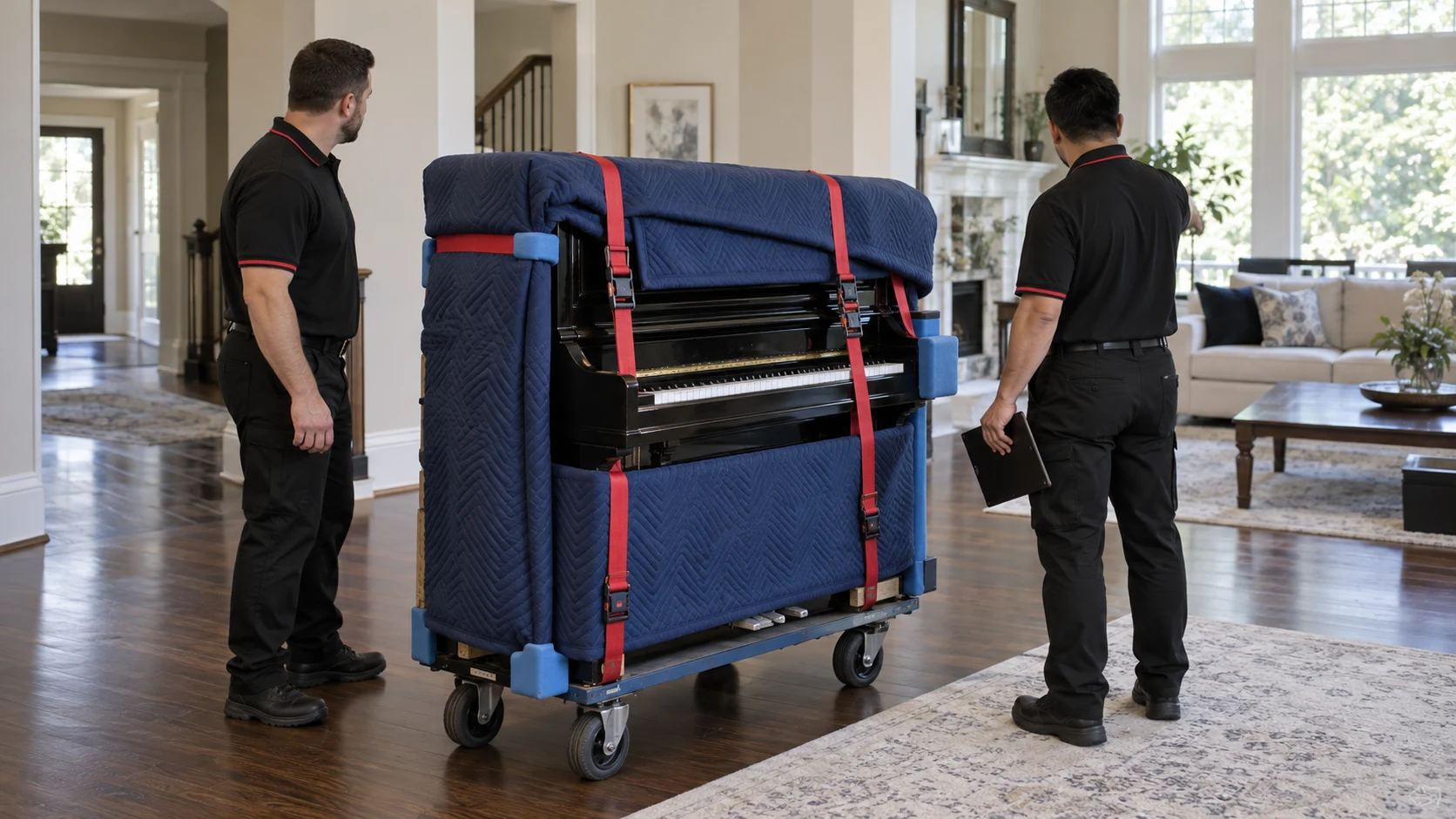
Safe and piano moving after a route survey

What needs to be agreed

A hydraulic lift is not suitable for every building or weight. Lifting, removing fixings and refitting them need an assessed scope. Opening a safe or tuning a piano after delivery is not automatically part of physical transport. The household calculator does not price these items.

Prepare these details

How the move is planned

  1. Share the inventory

    Send the collection and delivery locations, preferred date and a clear inventory. Photos help us identify missing information, but they do not automatically replace a site survey.

  2. Review access and the scope

    We review entrances, stairs, lifts and loading points, then identify packing, dismantling, transport and any work requiring another specialist.

  3. Agree the quote and responsibilities

    Check the included and excluded work, stages, contacts and receiving arrangements. Changes to the inventory or address need review before they become part of the plan.

  4. Prepare, move and hand over

    The team follows the agreed scope, with labels and inventory checks at delivery. Record visible observations at handover and keep important personal items with you.

Locations and availability

We welcome moving requests from all of Greater Cairo: Nasr City, New Cairo, the Fifth Settlement, the New Administrative Capital, 6th of October City, Sheikh Zayed, Maadi, Zamalek, Katameya Heights, Katameya Golf and New Giza. Our service covers every governorate in Egypt: Alexandria, the North Coast, Ain Sokhna, Suez, Hurghada, Sharm El Sheikh, El Gouna and beyond. We have worked everywhere in Egypt, and our crew reaches any address with the same planning and commitment. Send your area on WhatsApp and we will confirm the details and timing right away.

Survey and pricing

A quote depends on the inventory, volume, item type, distance, access and agreed packing, handling and assembly. We review the details and survey needs before a final offer. The household calculator is a planning tool, not a binding quote; it does not price company, factory, server, safe or piano moves, or inventories with unknown-volume items. Ask for the exact inclusions and exclusions before agreeing the work.

Frequently asked questions

Does an enquiry confirm a booking?

No. The team must review the request and agree the scope, availability and quote before the move is confirmed.

Is every task included automatically?

No. Packing, dismantling, handling, storage and specialist work depend on the written scope. Check the exclusions as well as the price.

What if my inventory or address changes?

Tell us before the move. A change can affect access, timing, equipment and price, so it needs review before acceptance.

For furniture storage in Cairo, ask about security, acceptance, access and written conditions. If climate-controlled storage is required, specify temperature and humidity needs and request confirmation; this page does not claim a climate-controlled facility. International packing standards depend on contents and route; fine art and piano moving need an individual review.

Piano moving: access, handling and care

Identify the instrument before asking for a price

An upright, grand and digital piano do not share one weight, access method or handling plan. Provide make/model if known, external dimensions and general condition photos. A model reference helps a specialist find the right specifications, but a brand name or photograph does not establish actual weight or route suitability. Say when weight is unknown rather than estimating from appearance.

State whether the piano moves alone or within a household move. List the bench, pedals, stands and other accessories separately. Do not enter a piano as ordinary furniture to obtain a household-calculator price. Concentrated weight, technical sensitivity and access require separate review. An enquiry form does not confirm a booking, date or method.

Packing

Measure the whole journey

Record the narrowest door, corridor width, stair flights, landings, overhead clearance and turns at both properties. Include thresholds, slopes, floor surfaces and distance from parking. Photos and video help explain the setting but do not certify the load capacity of stairs, balconies or lifts. Ask building management for actual lift capacity information.

Yamaha distinguishes uprights, which generally cannot be made smaller by simple dismantling, from grands that may need specialist component handling. Protective material and handling equipment add to the instrument dimensions. A door matching the piano width is not proof of clearance. This is planning context, not instructions for dismantling or tipping the instrument yourself.

Piano moving: access, handling and care

Leave method decisions to a specialist

Do not ask family members to carry or trial-turn a piano at a tight landing. Its own castors do not establish suitability for a journey across thresholds. Yamaha warns about tipping and uneven floors and recommends specialist advice. The instrument, route, equipment and control points need assessment before choosing a method. No fixed crew count or lifting recipe applies to every piano.

If external lifting, an alternative route or component work is proposed, that part waits for specialist review and building approval where required. Neither crane availability nor balcony load suitability is assumed. An unsuitable route calls for a changed plan or rejection, not a harder push. Keep children and pets away from the work zone.

Packing

Protection and condition records

Photograph sides, lid, keys, legs, pedals and existing marks before packing. Agree which parts a specialist handles and how accessories are identified and received. Protection and fixing methods must suit the finish and manufacturer guidance. Do not apply adhesive tape, polish or cleaning products yourself to prepare the surface.

Ask what the quotation includes for protection, handling, transport and acceptance, and excludes for tuning, old defects, repair or storage. Get liability, cover, exclusions, valuation and claims steps in writing. No visible scratch does not prove internal technical condition. Separate the transport record from a qualified technician's assessment.

Request an inventory review

Placement and care after arrival

Choose the destination position in advance to avoid repeated movement. Review floor level and load suitability with a specialist when needed, avoiding direct sunlight and heating or cooling outlets. Yamaha stresses stable humidity and qualified care. No universal tuning wait or humidity target is prescribed for every model; ask the technician about the instrument manual and room conditions.

Reconcile accessories, visible condition and position at delivery, recording reservations under the agreed terms. Ask a technician about checks and tuning once the instrument settles, especially after environmental changes. Transport does not automatically include tuning, voicing or action regulation. Start with type, model, dimensions, access photos at both ends, addresses, floors and preferred date.

Request an inventory review

Request an inventory reviewPacking

Manufacturer guidance: Yamaha, access · Yamaha, care ·

Piano moving and access review

A piano moving request in Cairo or Alexandria needs type, model, dimensions and both access routes, not just a date and price. Specialty or fine-item wording does not automatically accept every object or authorize dealing in archaeological material.

Move distance scope

Tier planning prices are fixed within Greater Cairo, and the calculator prices listed inter-governorate routes with a distance factor on the same tiers: Alexandria, the North Coast, Ain Sokhna, Suez, Ismailia, Port Said, the Delta governorates, Minya, Assiut, Hurghada, El Gouna, Sharm El Sheikh, Luxor and Aswan. Governorates outside the list get a custom quote on request after distance, inventory and access review. This is a pricing scope, not an administrative classification of cities.

Do calculator prices apply in every governorate?

Yes. The calculator prices the listed inter-governorate routes with a distance factor on the same Greater Cairo tiers. Choose the pickup and delivery governorates in the two lists; unlisted governorates get a custom quote on request after distance, inventory and access review.

Piano and safe survey file: information needed before moving

Pianos and safes both need special handling review, but they are different items. A piano is a musical instrument; a safe may be fixed and contain sensitive property. Prepare a separate file for each. Similar dimensions do not establish similar weight or handling.

Identify the piano first

State upright, grand or digital, with maker and model when known. Provide an overall photo, accessories and available dimensions. Do not open internal components or dismantle anything for a photo. Model details help review manufacturer information but do not replace site assessment.

Yamaha explains that upright pianos generally cannot be dismantled to become materially smaller, and protection and trolley size must also be considered. Grands involve different specialist handling of legs and pedals. This is survey preparation, not do-it-yourself dismantling or an invitation to tilt the instrument through a door.

Show the full property route

Document the route from current position to loading, and from unloading to final placement. Include doors, turns, stairs, landings, lifts and level changes. State vehicle-to-door distance. A floor number alone misses carrying distances and geometry that can affect planning.

Declare whether doors, rails or interiors changed since the piano entered. An old delivery method may no longer work. Door removal, alternate routes and lifting equipment need review, permission and responsibility boundaries. Offering lifting up to the 30th floor does not establish that every balcony or facade suits every item.

Record condition and accessories

List visible observations and accessories such as bench, separate pedals, cover or digital-piano music rest. Keep suitable condition photos and an existing technician report if available. Declare prior faults, loose parts or repairs relevant to handling before packing rather than leaving them to be discovered at delivery.

Separate cabinet-condition records from musical testing. Transport does not mean tuning, action regulation or pedal repair. Yamaha recommends trained piano technicians for tuning and maintenance. Decide who checks the instrument after placement and what needs a separate technical appointment. No single tuning date or treatment fits every instrument.

Review the final position

Choose the final location and route in advance and check the maker's environmental guidance. Yamaha highlights humidity and avoiding direct warm or cool airflow near the instrument. Appearance alone is not a placement plan, especially if furniture later blocks another move.

If fitout continues, discuss postponement or other arrangements before dispatch. An empty room or available store does not prove suitability. Storage needs review of site, period, environment, access and cover. No climate-control or humidity promise is made for an unverified facility.

Safe identity, fixing and contents

Provide maker, model, dimensions and reliable weight data when available. Say whether the safe is floor- or wall-fixed and who reviews removal and replacement of fixings. Appearance and outside dimensions alone do not establish weight or handling.

Review contents separately. Cash, jewellery and confidential records need explicit owner arrangements rather than assumed transport inside the safe. Never send combinations, access keys or opening information in a quote request. Appoint an authorised person for access or fixing matters when required without disclosing secrets unnecessarily.

Placement and building responsibility

Specify the exact safe position rather than a room name alone. Refer route and placement to building representatives and the appropriate specialist where flooring, anchoring or permission needs assessment. A moving team does not issue structural approval from a photograph. Do not assume a lift or surface can take the load.

Separate transport from other work in the quote. Tell the team if floor or final position changes. A change on moving day requires review rather than an improvised trial under deadline pressure. The aim is a reviewed method, not acceptance of any new instruction simply because the vehicle has arrived.

Quote and receive each item

For each piano or safe, prepare identity, dimensions, reliable weight where available, condition, both addresses, floors, route photos and tasks. Clarify protection, handling, lifting, insurance, taxes and specialist roles. The household calculator does not price these pieces, even if they are mentioned in a note.

At delivery, check the item, accessories and visible condition and record observations through the agreed process. Request policy terms and reporting procedures before confirmation; a general description does not establish a specific settlement. Moves can start in any Egyptian governorate and finish in any other, with the method and route covered in a custom offer.

Digital piano moving: model-specific preparation

A digital piano is not automatically a lightweight keyboard, and an acoustic piano's handling plan cannot simply be reused. A cabinet instrument, portable keyboard and digital grand have different construction. Start with the exact model and its manual, then agree the work and route. The points below are preparation questions, not instructions to lift or dismantle the instrument yourself.

Identify the instrument and the stand separately

Record the instrument model and the stand or cabinet model if they are separate products. State whether the stand is original, replaced or unknown. Provide an overall photo and accessible model information without opening covers or moving the unit just to reach a label. A similar external appearance does not prove that two digital pianos share mounting points or weight.

List the bench, music rest, pedals, power adaptor, cables and other accessories. Link each separate package to the instrument reference. A missing power adaptor or pedal can prevent a useful handover even when the main cabinet arrives. Do not place sensitive account details, purchase records or unrelated personal information on outside labels.

Use the correct manual before choosing component work

Yamaha explains that removal of digital-piano legs depends on the model and refers users to the assembly instructions in the owner's manual. This does not mean every stand or cabinet should be dismantled for every move. Provide the correct instructions to the competent person and agree what component work, if any, is included. Internal repair is not created by a transport instruction.

If original instructions or fittings are missing, declare that before the moving day. Do not substitute a procedure from another model or mix screws from household furniture into the instrument package. Keep any removed fittings identified under the agreed specialist process. The quotation should state who reviews dismantling, reassembly and the final stability check.

Orientation and protection are not space-saving guesses

Yamaha's digital-piano guidance calls for horizontal keyboard orientation during transport and storage, warns of possible keyboard problems from vertical positioning and says not to place objects on the keyboard unit. Make the model-specific guidance available during planning. Do not assume standing the instrument upright is acceptable simply because it saves floor space or lets a door close.

Route review still includes the packed dimensions, turns, thresholds, stairs and final position. The main unit and its protective packaging need room. An original carton, if available, should be disclosed for review rather than assumed suitable regardless of its condition or completeness. The transport team must assess the actual instrument and route before confirming the method.

Electrical accessories and personal setup

Identify the supplied power unit and cable connections relevant to the instrument. Arrange safe preparation and reconnection through the appropriate person and the model instructions. Do not improvise voltage adaptation, substitute an unidentified power supply or open the instrument as part of a move. Overseas placement may require a separate compatibility review; physical delivery does not certify electrical suitability.

If the instrument is used with a computer, audio system or saved personal setup, distinguish physical transport from reconnecting and configuring that system. The owner should make their own appropriate arrangements for personal settings or data before the move. A successful cabinet delivery is not proof that every external device or software connection has been restored.

Agree a meaningful delivery check

At delivery, reconcile the instrument, stand, accessory packages and visible condition against their references. Record whether assembly and the agreed checks are complete or whether something still awaits a competent person. Keep transport observations separate from a diagnosis of an electronic or keyboard fault. Do not force a key or connector to prove that the instrument works.

Ask in advance who is authorised to perform any functional check and what the written scope includes. A claim process, repair decision or technical warranty is not established by this checklist. Provide both addresses, model details, available manual, accessories, route information and requested work for an individual quote. The ordinary household calculator does not price a digital piano by guessing that it is a desk or cabinet.

Yamaha: digital piano transport

Yamaha: model manuals

Piano types, typical weights and what they mean for planning

Two pianos that look similar in a photo can need completely different crews, equipment and vehicles. Planning starts with the exact type, because type decides weight, center of gravity and whether any partial dismantling by a specialist is even possible. The ranges below are general orientation, not a substitute for the maker's data plate or a technician's assessment of your specific instrument.

Upright pianos

Uprights stand vertically and include spinet, console, studio and full upright models. Typical weights run from roughly 150 kilograms for a small spinet to 270 kilograms or more for an old full upright with a heavy cast-iron frame. Older European uprights are often far heavier than modern ones of the same height. An upright is moved as one piece: it is not taken apart to become lighter, and attempting to remove panels or the action without a piano technician risks damage that moving insurance may not cover.

What matters for planning is the weight, the height, and the condition of the casters. Small casters on a heavy upright can damage tiles or parquet and are not designed for rolling over thresholds or gravel. The instrument is normally walked short distances on its casters only over smooth, protected floors, and carried or dollied everywhere else.

Grand pianos

Grands range from a baby grand around 150 centimeters long to concert grands approaching three meters. Weights typically start near 250 kilograms and exceed 500 kilograms for large instruments. A grand is normally moved on a padded piano board after a specialist removes the legs and pedal lyre. This is skilled work: the instrument must be supported correctly while each leg comes off, and the lid and fallboard are secured so they cannot open under strap tension.

The longest dimension decides whether a grand fits through doors, turns and lifts once it stands on its side on the board. Measure the instrument, then measure the route. A staircase that accepts an upright may refuse a grand simply because of length on the turns.

Digital pianos and hybrids

Digital instruments are lighter and have no strings or soundboard, but they still contain electronics, speakers and polished cabinets that scratch easily. Many separate into a keyboard unit and a stand, which the owner's manual describes. Hybrids with real wooden actions deserve the same careful handling as acoustic instruments. Keep original cartons if you have them; they are the best protection a digital piano can travel in.

Why the type decides the plan

Type and weight decide how many movers attend, which equipment is loaded, whether floor protection must carry a point load, and whether a balcony or window lift is even an option. Tell us the maker, model and approximate age when you request a survey, and send photos from several angles. With that, the plan, the crew and the price are built around the real instrument rather than a guess that unravels on moving day.

Equipment and protection used for piano transport

A piano is not carried like ordinary furniture. The weight is extreme for the size, the finish shows every touch, and the internal mechanism dislikes shock and tilt beyond its design limits. Professional piano transport is mostly a matter of using the right equipment in the right order, and refusing to improvise when the planned equipment turns out to be wrong for the actual route.

Padding, covers and corner protection

Thick moving blankets and fitted padded covers protect the cabinet from straps, door frames and accidental contact. Corners and the keyboard lid get extra padding because they are the first points to touch a wall or a strap buckle. Stretch film holds blankets in place but never touches the polished surface directly. For high-gloss finishes, a soft inner layer goes on first so that no plastic or tape adhesive can mark the lacquer.

Piano boards, skids and dollies

A grand travels on a padded piano board: a long, reinforced platform on which the instrument lies on its side, strapped at multiple points so it cannot slide. Uprights move on heavy-duty dollies with rubber wheels that spread the load and protect floors. On stairs, the crew controls the instrument with straps and body position, one step at a time, with a spotter watching the lower end. Ramps bridge short stair runs where the geometry allows, and threshold plates protect door sills from the dolly wheels.

Lifting equipment for upper floors

When the internal route fails, an external lift is often the safer answer. MOVE ME EGYPT provides hydraulic lifting and winch or crane solutions up to the 30th floor where the building and the item suit this method. The decision is technical, not commercial: the team checks balcony or window dimensions, facade strength, the item's rigging points and the street position for the lift vehicle before committing. Permission from building management and, where needed, the local authorities is arranged before the lift is scheduled.

Inside the vehicle

In the truck the instrument stands or lies exactly as the method statement says, against a padded wall, strapped to anchor points so braking cannot shift it. Nothing stacks against a piano. Other cartons and furniture load around it only after it is secured, and nothing heavy is placed where it could fall against the cabinet on a rough road. Closed vehicles protect against dust, sun and the sudden humidity changes that a wooden instrument dislikes.

What you can check as a customer

Ask which equipment will be used for your specific instrument and route, and ask to see it before loading starts. Clean blankets, a sound board, straps without fraying and a crew that walks the route before touching the piano are good signs. A crew that begins by lifting before anyone has measured the doorway is not.

Stairs, lifts and balcony lifting: choosing the route

Most piano moves fail or succeed at the route, not at the piano. Three possible ways out of a building exist: the internal staircase, the elevator, and an external lift through a balcony or window. Each has conditions, and choosing between them is a measurement exercise done before moving day, not a debate held while the instrument hangs in the air.

When the staircase works

A straight staircase with generous width, strong steps and no tight intermediate landings can take an upright with an experienced crew. The crew measures clear width at the narrowest point, including handrails that may or may not be removable, and the turning space on every landing. Floor loading matters too: an old wooden staircase under a 300-kilogram point load deserves a careful look, and sometimes the building engineer's opinion. Spiral staircases and staircases with low ceilings over the turns usually rule themselves out.

When the elevator works

Measure the cabin's internal height, door width and diagonal, not just the door opening. An upright often fits standing; a grand on its board is a length problem and rarely fits a standard passenger cabin. Check the elevator's rated load against the combined weight of instrument, dolly and crew members who must ride with it. Book the elevator with building management for the moving window, protect its walls and floor with pads, and confirm the service key or priority mode if the building has one.

When the external lift is the right answer

Where stairs and elevator both fail, lifting through a balcony or window is usually safer and faster than forcing an impossible internal route. MOVE ME EGYPT operates hydraulic lifting platforms and winch or crane solutions up to the 30th floor. The review covers the balcony door or window opening, the clear drop zone at street level, overhead wires, the facade's ability to take the load path, and where the lift vehicle can stand. The instrument is rigged on its board with a protective cradle, never by straps around the polished cabinet alone.

An external lift needs permissions: from building management, sometimes from the compound's security office, and occasionally a street occupation permit from local authorities. Lead time for these approvals is part of the schedule we agree with you, so the lift vehicle, the crew and the permits all land on the same morning.

Deciding before the day

The route decision is one output of the survey. You receive a stated method for each address: which way the instrument leaves, which way it enters, and what equipment attends. If anything about the route changes after the survey, such as new furniture blocking a landing or construction scaffolding on the facade, say so before the crew arrives. A changed route is replanned, not improvised.

Preparing the instrument and the home on moving day

A piano move goes fastest when both the instrument and the building are ready before the crew touches anything. Preparation is not about helping carry; it is about removing every decision and obstacle from the crew's path so the actual handling takes minutes instead of hours.

Preparing the instrument

Close and lock the keyboard lid if it has a lock, and remove the key if there is one, keeping it with your personal items rather than in a carton. Do not tape the lid shut on a polished finish; the crew secures it with padding and straps. Take the music off the stand, empty the bench if it travels separately, and photograph the instrument from every side in good light, including close-ups of existing marks. These photos are your condition record and they take five minutes.

If a technician has serviced the piano, mention any known loose parts, previous repairs or a cracked soundboard before the move, not after it. Honest history lets the crew adjust handling, and it keeps the insurance conversation straightforward if anything is later questioned.

Preparing the route

Clear the path from the piano's position to the exit and from the truck to the final room: rugs that slip, small tables, plants, shoe racks, children's toys. Doors on the route come off their hinges or are fixed fully open, and door stops that sit in the swing path are removed. In an apartment building, warn the neighbors on the moving floor and reserve the elevator; in a compound, register the truck and crew with security the day before so the gate does not cost the first hour of the morning.

Preparing the destination

Decide the exact final position before the crew arrives: which wall, how far from it, which way the keyboard faces. A piano placed 'temporarily' in the wrong room is a second move waiting to happen, and pianos do not enjoy being moved twice. Mark the spot with tape on the floor. Check that the floor at the final position is level and can take the load, especially for a grand whose weight concentrates on three small points. Caster cups under the wheels protect both the floor and the instrument, and the crew places them as part of the positioning.

What the crew needs from you

One decision-maker reachable by phone, keys to both properties, the gate and elevator bookings confirmed, and children and pets in a separate room while the instrument is moving. Beyond that, the best help is distance: let the crew work the route without an audience in the carrying path.

After the move: acclimatization, tuning and care

The move ends when the piano stands in its final position, but the instrument's settling takes longer. Wood, felt and glue joints respond to changes in temperature and humidity, and a piano that crossed Cairo in a closed truck has experienced a different climate than your living room will give it. What you do in the first weeks after delivery protects both the sound and the structure.

Let the instrument settle before tuning

Piano technicians commonly advise waiting before the first tuning after a move, often two to four weeks, so the instrument can adjust to its new room. Tuning a piano that is still acclimatizing means paying twice: the strings drift as the wood settles and the tuning does not hold. Ask your technician for a recommendation based on your instrument and the season, and book the tuning visit for after that window rather than the day after the move.

Choose the wall with the climate in mind

Makers and technicians consistently recommend keeping pianos away from direct sunlight, exterior walls that heat up, air-conditioning outlets and heaters. A steady, moderate room is the goal. In Egypt this usually means an interior wall, out of the path of the split-unit airflow, with curtains drawn against the afternoon sun. Humidity swings matter more than the exact number: a room that dries out at night and humidifies by day tires the soundboard faster than a stable room slightly outside the ideal range.

First checks after delivery

Play every key slowly and listen: notes that stick, ring oddly or stay silent deserve a technician's attention, and mentioning them promptly keeps any warranty or insurance question simple. Check the pedals for normal resistance. Look over the cabinet in daylight and compare with your pre-move photos; report any new mark through the agreed process while the details are fresh. Keep the photos and the delivery note together.

Cleaning and daily care

Dust the cabinet with a soft dry cloth. On high-gloss finishes, avoid household polishes and sprays unless the maker approves them, because silicone products can cloud the lacquer and complicate future repairs. Keep drinks, flower vases and potted plants off the lid: condensation rings and spills reach the soundboard faster than most owners expect. Inside the instrument, leave cleaning to the technician who services it.

When a move exposes an old problem

Occasionally a move reveals something that was already wrong: a hinge that finally lets go, a glue joint that separates after years of quiet weakness. A condition report made before the move is what separates transport damage from age. That is why the survey photos matter, and why honest disclosure of the instrument's history serves the owner as much as the mover.

Choosing a piano mover: questions that protect you

Every moving company will say it can move a piano. The questions below separate the ones that actually plan for it from the ones that plan to improvise. Ask them before you book, and treat vague answers as answers.

Ask about method, not promises

How will my specific instrument leave this specific building? A serious answer names the route, the equipment and the crew size, and it comes after a survey or at least a video review of both addresses. 'We are careful' is not a method. Neither is 'we have done many pianos' without any description of how yours will be handled.

Ask what the insurance actually covers

Request the policy terms before you confirm: what is covered, what is excluded, the excess, and how a claim is reported and settled. Full insurance is only meaningful when you know the process that stands behind the words. Ask whether the cover applies for the whole door-to-door journey, including the carrying stages inside both buildings, and ask for that in writing.

Ask who does the specialist work

Grand pianos need legs and pedal lyre removed and refitted; some instruments need a technician's attention before or after the move. Ask whether the mover handles this with trained staff, brings a specialist, or expects you to arrange one. All three models can work, but you should know which one you are buying and what it costs.

Ask for the survey file

A professional mover keeps a file on your move: photos, measurements, the agreed method, the price and its scope. Ask what you will receive in writing before the day. A company that writes things down is a company you can hold to them.

Red flags worth heeding

A price given for a grand piano without a single question about the model or the floors. A crew that arrives without blankets, board or straps and asks what you have available. Pressure to decide today because 'the schedule is full'. No written scope, no survey, no mention of insurance terms. And any suggestion that a heavy upright can simply be 'walked down' a staircase that nobody has measured. A piano is usually among the most valuable single items in a home; the mover you choose should treat it that way before you ask them to.

How we work

MOVE ME EGYPT surveys every piano move before pricing it, in person or by video, and confirms the method, equipment, insurance coverage and price in writing. Our crews handle uprights, grands and digital instruments across all Egyptian governorates, with hydraulic lifting and winch solutions up to the 30th floor where the building calls for it. Send us photos of your instrument and both addresses, and we will tell you exactly how your piano will travel.

Storing a piano and moving one across Egypt

Two situations extend a piano move beyond a simple morning job: the instrument needs storage between homes, or it is traveling to another governorate. Both are common, both are manageable, and both punish improvisation. This is how to think about each.

When a piano needs storage

Renovations, handover delays and travel between homes all create gaps where the piano cannot go straight to its final room. A wooden instrument is the wrong guest for a random lock-up. Ask four questions of any storage arrangement: Is the space dry and ventilated, away from exterior walls that sweat in winter? Is the floor level and strong, with the piano kept off bare concrete on a platform or battens? Is the instrument fully wrapped in breathable covers rather than sealed in plastic that traps condensation? And who holds the key, with what access record?

MOVE ME EGYPT keeps storage in our own warehouses, where furniture is wrapped, labeled and stacked by zone rather than piled. For pianos we add the instrument-specific precautions above, and the same condition photos taken at collection follow the item into and out of storage. Tell us the expected duration when you book; a month and a year are different arrangements, and honest dates let us position the instrument so it does not have to be re-handled every time another item enters or leaves.

Long-distance piano transport within Egypt

Moves from any Egyptian governorate to any other are part of our regular work: Cairo to Alexandria, the Delta, Upper Egypt, the Red Sea coast or the North Coast in season. Distance changes three things. First, the schedule: a same-day delivery to a nearby governorate is realistic, while longer routes are planned around daylight driving and your arrival window at the destination. Second, the securing: hours on the road mean the instrument is braced and strapped for sustained vibration, not just city braking, and checked at the first rest stop. Third, the coordination: the destination end needs the same preparation as a local move, meaning gate access, elevator booking and a decision-maker present when the truck arrives.

For long routes we load the piano last so it unloads first, keeping it out of the truck during the rest of the delivery. If your piano shares a vehicle with the rest of a household, the loading order is planned around it. If it travels alone, the vehicle is chosen to fit the instrument and its protection, not the other way around.

Seasonal and coastal notes

North Coast summers and Red Sea destinations add two factors worth planning around: heat in transit and salty, humid air at the destination. The closed vehicle handles the first; your choice of room handles the second. A piano going into a coastal home that stands empty for weeks benefits from the climate placement advice in the after-move section above, applied from day one rather than after the first sticky key. Where a home will sit closed for long periods, tell your technician; there are humidity-control options for pianos that a technician can fit, and they are cheaper than the damage they prevent.

Timing the whole chain

Collection, storage, long-distance transport and final placement are one chain, and it is priced and scheduled as one. When you request a quote, give us the full picture: both addresses, any storage gap with honest dates, the floors and access at both ends, and your preferred window. A single written plan covering the chain is what turns a complicated piano journey into a routine one.

When the piano moves with the rest of the household

Most pianos in Egypt move as part of a full household move, not as a standalone job. Combining both is sensible and usually cheaper than two separate engagements, but it needs one adjustment in thinking: the piano is not one more carton on the inventory. It is the item the whole loading plan bends around.

How we sequence a combined move

On a combined job the piano is prepared first, while the crew's attention is fresh and the route is still empty of cartons. It is wrapped, boarded if it is a grand, and moved to a safe staging point near the exit, or straight to the vehicle if the loading order allows. General packing then proceeds around that rhythm. At the destination the order reverses: the piano is placed in its marked position before the rooms fill with cartons, so nobody carries a sofa across a floor where a 300-kilogram instrument is about to travel.

One survey, one file

A household survey that includes a piano takes the instrument through the same questions this page describes: type, route, equipment, insurance scope. The piano appears on the written plan as its own line with its own method, not buried in the room list. If your home also holds a safe, a large aquarium or any other exceptional piece, each gets the same treatment. The household volume calculator on this site prices ordinary rooms; exceptional items are priced in the custom offer that follows the survey.

If your dates do not line up

Sometimes the piano must leave before the household, or stay behind after it: a new home still being finished, a buyer collecting the old piano on a different day, a family traveling ahead. Tell us the real dates and we split the move sensibly. A piano collected early can wait in our warehouses under the storage arrangements described on this page, then join the main delivery or follow it. What matters is that each leg is planned, recorded and covered, not that everything happens on one truck on one day.