MOVE ME EGYPT SERVICES
Furniture and equipment transport
Before choosing transport, we need to understand the actual load. Household furniture, office equipment, sensitive devices and heavy pieces need different preparation and handling. We review the inventory and both sites, separating special items rather than treating everything as an ordinary furniture carton.
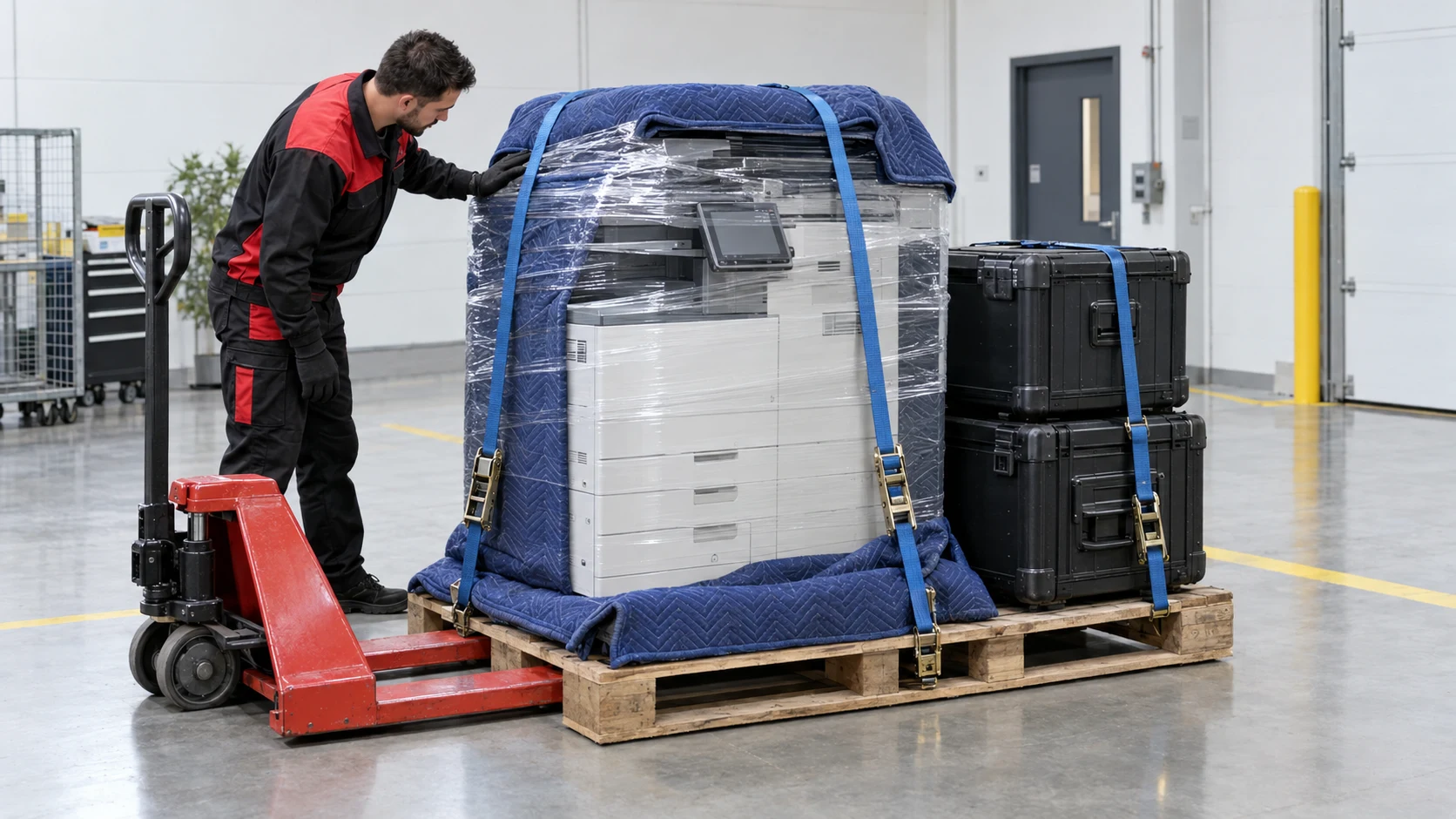
Separate furniture from technical equipment
A desk, refrigerator, machine and safe do not form one uniform load. Provide dimensions, reliable weights, condition and any technical dismantling, isolation or protection needs. Route photographs help but do not replace assessment of complicated cases.
Fixed equipment or utility-connected devices must be released ready by the responsible specialist. Switching off is not a sufficient assumption of safety. Declare hazardous goods, liquids, batteries and sensitive components before quotation. No promise covers every machine or weight without checking resources and route.
Coordinate protection, handling and receipt
Associate every removed component and accessory with its parent identifier. Protection depends on finish and sensitivity as well as size. Explain direct delivery or storage because duration and repeated handling affect preparation.
Specify permissions, loading, unloading, handling resources, receiving contacts and technical tests. Price covers the agreed written scope only. Installation, calibration, defect repairs and site alterations are not presumed. At delivery, reconcile the list and observations and keep physical acceptance separate from operational sign-off.
What a moving and transport service actually covers
The phrase 'movers and transportation' sounds like a truck and two strong backs, and that is exactly the gap a professional service exists to close. A proper move is a chain of linked stages, survey, packing, loading, transport, delivery and placement, and the value is in the chain, not in any single link. A truck that arrives without the stages around it is transport; what a household or a business actually needs is the move.
The chain starts before anything is touched. The survey turns a home or an office into a plan: volume, access, special pieces, the sequence of the day. Packing turns contents into cargo that can survive handling. Loading arranges that cargo so it travels safely and unloads in a useful order. Transport is the link everyone imagines, and it is genuinely the shortest part of the job.
Delivery is where the service proves itself: placement in the right rooms, reassembly of what was dismantled, and a walkthrough that closes the job with the customer, not just near them. The difference between a mover and a transporter is visible in that last hour, a mover's work ends when the home works, not when the vehicle empties.
Scope is agreed in writing before the date. What is included, what is optional, what the customer handles, packing materials, dismantling, appliance disconnection, storage, each line is named. A written scope is not paperwork for its own sake; it is what makes the moving day boring, and boring is the highest praise a moving day can earn.
The survey: how a move is assessed
Every accurate quote and every calm moving day begins with the survey. Done in person or by video, it is the half hour that converts 'a three-bedroom flat' into the numbers a move is actually planned with: the volume to be carried, the access at both ends, the pieces that need special handling, and the crew and time the job will take.
Volume comes first, because volume decides everything downstream: the vehicle, the crew size, the packing materials, the hours. An experienced surveyor does not count rooms; they count what is in them, including the storage spaces everyone forgets, balconies, roof rooms, the cabinet above the wardrobe, until the list matches the household rather than its floor plan.
Access is the second pillar, and it is where surprises hide. Staircases and their turns, lift dimensions and booking rules, how far the vehicle can stop from the door, the hours a building allows work, each one changes the labor a day requires. A survey that measures access honestly protects the customer from the worst sentence in this trade: 'that will cost extra on the day.'
The special pieces get named individually: the safe, the piano, the glass display, the appliance that needs a technician, the wardrobe that must come apart to leave the room. Each is a small plan of its own, equipment, protection, sequence, and naming them in the survey is what keeps moving day free of improvisation.
What the customer receives is the survey's real product: a written scope and a quote built from facts, valid for a stated period, with the assumptions visible. If two quotes differ wildly, the difference is almost always in the survey, one of them guessed.
Loading and securing: the hour that decides the day
A load is not a pile; it is a structure. The order and method of loading decide how the cargo rides, how it unloads, and whether anything rubs, shifts or crushes on the way. Professional crews load against a plan formed during the survey, and the plan has rules that never bend.
Weight goes low and forward: appliances, cartons of books, the dense pieces form the base. Furniture travels wrapped in padded blankets, standing as it was designed to stand, with drawers and doors secured so nothing swings. The fragile and the finished surfaces ride protected by the load around them, never as the load's outer skin.
Everything that can move is restrained. Straps anchor the tiers to the vehicle's lashing points, blankets and edge protectors sit where pieces touch, and gaps are filled rather than ignored, because a load that can shift will shift, at the first hard brake. The crew chief walks the load before departure the way a pilot walks an aircraft: once around, touching what should not move.
The load order is also the unload order. What must come off first at the destination, the pieces the family needs to function that evening, goes on last. It sounds obvious and it is routinely violated by hurried crews, which is why the loading plan is agreed before the first carton moves, not improvised at the vehicle.
The last act before departure is documentation: the inventory checked against what is loaded, the seal or closure noted, and the customer holding the list. From that moment the cargo's story is written down, and anything the road tries to add to the story will be visible at delivery.
In transit: routing, timing and staying in touch
Once the doors close, the job changes from handling to stewardship. The cargo rides under the driver's care, and the professional disciplines of that stage are unglamorous: a route chosen for the load, a pace that respects what is aboard, and communication that keeps the customer informed without being asked.
Routing is decided by the cargo, not by habit. Low bridges, rough surfaces and congested stretches cost more time in damage and delay than a longer smooth road. Within Greater Cairo, timing against traffic is half the craft; a crew that knows when the bridges clog schedules around them, and an intercity run plans its rest and fuel stops before it leaves.
The schedule is honest from the start. A move has an arrival window, not a magic minute, and the window is quoted with its reasoning, distance, known traffic, the unloading access at the far end. When something on the road changes the estimate, the customer hears it from the crew first, with the new time and the reason. Silence is the only true failure in transit; everything else is information.
Longer hauls add their own rules. Overnight stops happen in watched parking with the vehicle locked and checked; sealed loads stay sealed until delivery; and the customer knows before departure what the plan is, so nothing about the journey arrives as a surprise.
Transit ends where it began, with a check. Doors open against the inventory, and the condition that left is the condition expected. A well-run transit stage is the one nobody remembers, which is exactly the standard it is held to.
Delivery day: unloading, placement and reassembly
Delivery is the mirror of loading, run with the same discipline in reverse. The vehicle arrives within its window, the crew walks the new space before anything leaves the vehicle, and the unload follows the plan written at the origin: room by room, heavy before light, cartons to the rooms their labels name.
Placement is a service in its own right, not a favor. Furniture goes where the customer directs, assembled pieces stand level on the real floor, and the pieces dismantled at origin go back together from their labeled hardware. The crew that packed the piece, or holds its photographs and notes, reassembles it faster and kinder than any stranger could.
Floors and walls at the new home get the same protection as the cargo did: runners on the paths the crew walks, corner guards where turns are tight, door jambs padded where furniture passes. A move that leaves the new home unmarked has finished properly; one that trades speed for scuffs has merely stopped.
The day closes with the customer, not with the crew. A walkthrough room by room, the inventory checked off as pieces appear, debris and packing material removed, and any exception noted in writing while both sides are present. Signatures happen at the end of that walkthrough, when the paper matches the rooms.
What remains after a good delivery is oddly little: a home that works, a list fully ticked, and a crew that leaves before it becomes a memory. That smallness is the product. The move was always supposed to disappear into the life it was serving.
Equipment and machinery transport
Not everything that moves is furniture. Businesses and households both own equipment, gym machines, catering lines, medical and laboratory devices, workshop machinery, generators, and moving it is a different discipline from moving a sofa, because equipment carries weight in the wrong places, connections that must be documented, and calibrations that do not forgive rough handling.
The survey for equipment asks different questions: weight and its center, the points a machine may be lifted from and the points it may not, the connections, electrical, water, gas, data, that must be closed by whom and in what order, and the access at both ends measured against the machine's real dimensions, not its optimistic ones.
Preparation is half the move. Fluids drain, moving parts lock or remove, fragile assemblies come off and travel separately, and every disconnection is photographed and labeled so reconnection is a procedure, not a puzzle. Where the manufacturer specifies handling, that specification is the plan; where it does not, the crew writes one and follows it.
In transit, equipment rides on the gear built for it: skates and dollies rated for the weight, ramps and lift gates where stairs make them necessary, and a place in the load where nothing rests against it. The same load rules apply, low, restrained, padded, with an extra one added: nothing leans on a machine.
Placement ends at the machine's working position, leveled and, where the scope includes it, reconnected by the agreed hands. The handover notes what was disconnected and reconnected, so the owner's technician starts from facts. Equipment moves well when it is treated as what it is: an instrument with an address change, not a heavy box.
Special items: safes, pianos, glass and art
Every household has a short list of things it would not forgive losing, and every professional move treats that list as a project within the project. Special items share one trait: the ordinary method fails on them, in weight, in fragility or in value, so each gets its own plan, its own materials and often its own moment in the day.
Safes and very heavy pieces move on rated equipment with a planned path, floor load checked, stairs assessed honestly, sometimes a crane or an external lift through a balcony rather than a staircase that cannot take the weight. The honest answer occasionally is that a piece cannot leave the way it came in, and saying so at the survey is what surveys are for.
Pianos are their own trade: the lid and pedals protected, the body wrapped and strapped to a skid, carried by enough hands on a planned route, and tuned after it settles, not before anyone asks. A piano that arrives on pitch was lucky; a piano that is booked for tuning arrived properly.
Glass, marble and mirrors travel out of their frames, in cartons or crates built for them, marked and loaded where nothing bears on them. Art moves wrapped by material, canvas, glass, gilding each wants different contact, with condition photographs before wrapping and, past a certain value, a crate and an individual insurance line.
The common rule across all of them is time. Special items are never rushed, never loaded in a hurry at the end of a long day, and never handled by fewer people than the piece demands. The premium a customer pays for them is mostly patience, bought by the hour.
How a move is priced
A move's price is built, not plucked, and a customer who understands the building blocks can read any quote in a minute. The blocks are few: the volume or weight carried, the access labor at both ends, the packing and materials, the distance and duration of transport, the special items, and the extras the customer chooses, storage, assembly, disposal.
Within Greater Cairo, much of this compresses into the published tiers, sized by home, because surveys across thousands of similar flats produce reliable patterns. Outside Greater Cairo, or for loads that do not fit a pattern, the quote is individual: the same blocks, priced from the survey rather than the table. Either way, the customer should be able to see which block carries which cost.
The honest quote states its assumptions: the volume it surveyed, the access it saw, the dates it covers and how long it stays valid. It names what is excluded as clearly as what is included, because the exclusions are where moving-day arguments are born. A quote without assumptions is not cheap; it is unfinished.
Two moves with identical volumes can price apart for good reasons, a fifth floor without a lift is a different job from a ground-floor villa, and that is not unfairness, it is labor. The question to ask any mover is not 'why is yours higher' but 'show me what yours includes', and the answer should arrive as lines, not adjectives.
Deposits and payment terms belong on paper too: what confirms a booking, when the balance falls due, and what changes the price legitimately, a date moved, a volume grown, a piano discovered. Written terms do not prevent every dispute; they end most of them in one page.
Insurance and responsibility on moving day
A move hands everything a household owns to other people, so the question of who answers for it is not nervousness; it is due diligence. The answer has two layers, the mover's responsibility and the insurance policy, and a careful customer understands both before the first carton closes.
The mover's responsibility is the operational layer: what the crew breaks, the mover makes right, under the terms agreed in writing. Those terms should say how damage is reported, within what window, against what evidence, and how settlement works. The delivery-day discipline, exceptions noted on the spot, photographs, both signatures, exists to make that layer function without argument.
Insurance is the financial layer, and it pays against declared value. A policy covering 'the shipment' at a guessed lump sum invites a reduced settlement; one tied to a valued inventory pays line by line against the list. High-value pieces past the per-item ceiling are declared individually, with photographs, so the value is agreed before there is anything to dispute.
Exclusions deserve the same reading as coverage. Owner-packed cartons, cash and documents, pieces with pre-existing damage noted at the survey, items prohibited from transport, each policy draws its lines, and the time to see them is before booking. Professional packing is commonly a condition of full cover, which quietly answers the question of whether packing is worth paying for.
The test of the whole arrangement is simple: if something breaks, everyone already knows the next step, the window and the evidence, because it was written down when nothing was broken. That is the difference between a claim and a quarrel.
Preparing your home for moving day
The customer has a part in a professional move, and it is neither heavy nor technical: it is the handful of decisions and separations that let the crew work at full speed without asking. A home prepared for moving day loses an hour less to questions, and the hour is the unit moving days are priced in.
Decide what does not travel before the crew arrives. The items staying, selling or being discarded are marked or gathered in one agreed space, so 'does this go?' never has to be asked room by room. The personal kit, documents, medications, chargers, jewelry, the children's essentials, a few days of clothes, lives in a closed room or a car, clearly outside the packing scope.
Appliances need their own evening-before: the fridge emptied and defrosting, the washing machine drained, the gas cooker disconnected by whoever is qualified to disconnect it. Electronics unplug and their cables bag with them; the photograph of the back of the television before unplugging is the cheapest insurance on the move.
Access is the customer's half of logistics: the lift booked if the building books lifts, the parking space held as close to the door as the building allows, the neighbor warned, the guard informed of the crew's names and the vehicle. Ten minutes of messages the day before buys a calm first hour on the day.
Finally, be reachable and decisive. One person who can answer 'where does this go?' keeps twelve hands moving. Everything else, the crew has done a thousand times, and a prepared home lets them simply do it once more.
Choosing the date: timing, seasons and booking ahead
The date of a move decides more of its cost and calm than any other single choice, and it is the choice customers most often make last. The moving trade has tides: month-ends when leases turn, the weeks before and after the school year, the pre-holiday rushes, and booking into a tide means paying for it in schedule pressure if not in price.
The simple rule is to book early into busy windows and freely into quiet ones. A mid-month, mid-week date can often be confirmed on short notice; the last weekend of a month wants weeks of lead time, and the popular seasons want more. Early booking does not only secure the date; it secures the good part of the day, the morning start that leaves margin for everything after it.
Within the day, the same logic holds. Crews and buildings favor the morning: lifts are freer, traffic thinner, tempers longer. An afternoon start compresses everything into the hours when the city is least cooperative, and the saving is rarely worth the squeeze.
Egypt adds its own calendar to the trade's tides. Ramadan changes working rhythms and building rules; summer moves want early starts against the heat; the days around public holidays compress availability. None of this forbids moving; all of it rewards mentioning the date early and letting the plan respect the calendar it lands on.
The contingency belongs in the same conversation. A date can usually move within an agreed window without penalty, while a cancellation the day before cannot. Asking 'what if our date slips?' at booking time costs nothing and converts a future emergency into a line in an email.
The moving-day mistakes everyone makes once
Most moving-day failures are not bad luck; they are the same dozen mistakes repeating across households, and knowing them is most of the way to not making them. They share a root: something that should have been decided on a calm Tuesday gets decided on a frantic Friday, in a hallway, at double the cost.
The first family of mistakes is volume. Booking from a guess, 'it's a normal two-bedroom', and discovering on the day that the balcony, the storage room and the rented furniture were not in the guess. The quote collapses, the vehicle is short, the day stretches. The survey exists precisely because nobody's memory of their own belongings is accurate; everyone owns more than they think.
The second family is packing against the clock. Starting the night before, running out of cartons at midnight, taping shut boxes whose contents were never chosen. Owner-packed is a legitimate choice, but it is a week of evenings, not a night, and the carton count always runs thirty percent past the estimate.
The third family is paperwork and access. The lift not booked, the building not informed, the parking space taken by a stranger, the new landlord unreachable for the keys. Each is a five-minute fix on any day except moving day, when each becomes an hour. The checklist is short and boring, which is why it works.
The last mistake is silence: not telling the mover about the safe, the piano, the narrow turn on the third floor, the dog. Surprises do not make crews work faster; they make them stop and re-plan. A mover who knows everything in advance looks unremarkable on the day, and that unremarkable day is what was paid for.
Choosing a mover: the questions that sort the field
Every mover sounds careful in an advertisement, so the sorting happens in conversation, and the questions below do it quickly. None of them is clever; all of them force a specific answer, and the difference between movers lives in the specifics.
Ask how the quote is built and from what survey, in person, by video or by guess, and ask to see the assumptions in writing. Ask what the price includes and excludes, line by line, and how long it stays valid. Ask what happens when the volume turns out larger on the day, and listen for a procedure with a rate, not a shrug with a multiplier.
Ask who actually comes: whether the crew is the company's own or assembled for the day, how many hands the survey priced, and who leads them. Ask what protection travels with the load, blankets, straps, corner guards, floor runners, and what equipment special pieces get. A company that answers in materials has the materials.
Ask about the paper: the written scope, the inventory practice, the damage reporting window and the insurance options with their wording. Ask what the deposit confirms and when the balance falls due. Paper questions feel formal until the first scratch; after it, they are the only questions that matter, and the mover who answered them in advance is the one still answering the phone.
The pattern to listen for is eagerness about the survey and patience with the questions. A mover who wants to see your home before pricing it, and answers the boring questions without hurry, is describing how they will behave on the day. The conversation is the sample; treat it as one.
Storage in the middle of a move
Moves rarely join end to end. The new lease starts after the old one ends, the renovation runs long, the shipment date and the key date refuse to meet. Storage is the hinge that lets the two halves of a move swing independently, and used deliberately it turns an impossible week into two ordinary ones.
The arrangement that works is the one decided before packing day: what portion stores, for how long, with what access during the stay. Packing for storage differs from packing for direct delivery, cartons are sealed for duration, furniture is wrapped to breathe, and the inventory is written so that a single carton can be retrieved mid-storage without disturbing the rest.
The questions that matter about a facility are plain ones: how it is secured and who can enter, how it behaves across an Egyptian summer, how the stored goods are recorded and insured, and how retrieval works, notice needed, minimum quantities, the price of taking one room's worth early. Answers that arrive in writing before booking are the kind that hold up later.
The exit is planned at the entrance. When the new home is ready, the stored goods move on the same discipline as the first leg: a crew, an inventory check at both ends, placement by room. A move with a storage leg costs an extra handling, and that is the honest price of the hinge; what it should never cost is condition, which is why the packing standard does not relax in storage.
Used this way, storage is not a failure of planning but a tool of it, the difference between forcing two dates to meet and letting each arrive in its own time.
Moving day, hour by hour
A well-run moving day has a shape, and customers who know the shape can tell by ten o'clock whether their day is on plan. It begins early, because mornings are the day's margin: the crew arrives, the crew leader walks the home with the customer, confirms the scope, the stays-and-goes, the special pieces, and sets the sequence. Nothing is wrapped before that walk.
The middle hours divide the home. Packers work room by room, cartons close numbered and labeled, furniture is wrapped where it stands, and the special pieces get their planned moment, not the last tired hour. The customer's job through all of it is to be findable and to decide, nothing more; twelve hands move faster behind one clear voice.
Loading takes its own deliberate hour or two against the plan, heavy low and forward, fragile protected, the evening's pieces in last. Before departure the inventory is checked against the load, the closure is noted, and the customer holds the list. The transit window is reconfirmed with the crew, who have become the customer's single point of contact for the rest of the day.
Delivery runs the morning in reverse at the new address: walkthrough first, protection down, unload by room, reassembly from the labeled hardware, placement where the customer points. The day closes as it opened, with a walkthrough together, exceptions written while both sides are present, debris leaving with the crew.
A day that follows this shape ends early in the evening with a working home and a signed paper that matches the rooms. Days that go wrong almost always went wrong at the walkthrough, the ten minutes that were skipped to save ten minutes.
The materials that protect a move
Ask a crew what separates a professional move from a borrowed-truck one and they will point at the materials before the muscle. Protection is consumable: it is bought, carried, used up and replaced, and the willingness to spend it generously is most of what 'careful' means in practice.
The carton is the unit of the trade, and not all cartons are equal. Double-walled boxes carry books and kitchenware without bulging; single-wall suits linens and light plastics; wardrobe cartons move clothing on its hangers; dish packs and cell dividers give glass its own geometry. The right carton costs piastres more than the wrong one and decides the condition of what is inside.
Wrapping works in layers, each with a job. Blankets take the knocks and the friction; stretch film holds the blankets and keeps drawers honest; bubble and foam meet glass and finished surfaces that must not be touched by anything harder; corner guards concentrate on the places impacts concentrate. Paper fills the voids, because a packed carton is a solid object and a half-packed one is a rattle with ambitions.
Tape, labels and markers are the least glamorous materials and the most diagnostic. A crew that labels every carton with number, room and contents is a crew whose delivery day will run like the packing day did. The marker is the planning department of the truck.
Customers see the materials for exactly one day; the crew lives by them. When comparing quotes, the line for materials is the wrong place to hunt savings, it is the smallest number on the page with the largest effect on everything the page protects.
Local moves, intercity moves and knowing which yours is
The same crew and the same care serve a move across the street and a move across the country, but the two jobs are planned differently, priced differently and scheduled differently, and a customer who knows which job they have asks better questions of it.
A local move, within the same city, is a one-day organism: load in the morning, deliver in the afternoon, sleep in the new home that night. Its pricing rides on labor hours and volume, which is why the published tiers work within Greater Cairo, the patterns repeat. Its risks are access and timing, and its cure is the survey and the morning start.
An intercity move is a small expedition. It prices from the survey rather than the table, because distance, route and duration join the calculation; it schedules around a longer transit with its own rules for rest stops, sealed loads and arrival windows; and it protects more, because the cargo rides hours of road instead of minutes. Any route outside Greater Cairo, between governorates or to the coastal and resort cities, is quoted individually after review.
Between the two sits a practical question worth asking early: does everything move in one day, or does the distance argue for an evening load and a morning delivery? The answer changes crew hours, building bookings and the family's night, and a good coordinator raises it before the customer has to.
Either way the spine does not change: survey, written scope, disciplined packing, a planned load, honest transit windows, a delivery walkthrough. The kilometers differ; the standard does not.
After the move: the first week and the follow-up
The crew leaves, the door closes, and the move enters its least discussed phase: the week the household discovers whether the move actually worked. A professional service plans for that week too, because its reputation is decided there, in the drawers that open and the legs that do not wobble.
The first days belong to unpacking in the order the labels wrote: beds and kitchen first, the rooms that make life function, then the rest at the household's own pace. Owner-unpack is the normal arrangement, and the cartons were packed for it, numbered, roomed and listed, so the household always knows what remains unopened.
This is also the claims window, and it rewards promptness. Damage that hid inside a carton surfaces on opening, and the rule is simple: photograph before touching further, note the carton number against the inventory, and report within the agreed window. Claims reported inside the window with photographs are administration; outside it, they are negotiation.
The follow-up is the mover's half of the week: a call or message after delivery, the answer to the small questions every new home generates, and the claim file carried to its close if one exists. A company that disappears at the door has told the customer what the signature meant to it.
A move done right ends unremarkably: a home in full function, a closed file, and a name saved in the phone for the next time. In this trade, the quiet ending is the loud one, it is the one customers repeat.
Moving day with children and pets
A moving crew works fastest in a home that contains only furniture, so the kindest thing a family can do for its children and animals is to plan their day elsewhere, or at least elsewhere-adjacent. The doors stand open all day, strangers carry large objects through every room, and the usual anchors of routine are being loaded into a vehicle; the plan should absorb that, not fight it.
Children do best with three arrangements: a person who owns them for the day, a space that stays normal until the end, and a role that makes them participants rather than obstacles. Their room packs last and unpacks first, the kit of irreplaceable objects travels with the family, and a small job, labeling their own cartons, choosing where their desk stands in the new room, buys cooperation better than any promise.
Pets need stricter logistics because they cannot be told the plan. Moving day is open doors and noise, so animals travel last, from a closed room they occupied until the final hour, in their own carriers with familiar bedding. The new home receives them into one prepared room, food, water, litter or pads, before the rest of the house fills around them; cats in particular forgive a move in proportion to how small their world stays during it.
The crew's part is simple and worth confirming at booking: they are told about the animals, they respect the closed-room arrangement, and the doors they prop open are watched when an animal is still inside. A one-line note in the job sheet prevents the one kind of loss no insurance settles.
Families that plan this layer well report the same result: the move reads in memory as an adventure the children helped with and the animals survived unbothered, which is as close to a perfect moving day as households get.
The master checklist, from booking to settled
Everything in this guide compresses into one list, and the list is worth printing. It runs in the order a move runs, and each line done on time is a surprise that never happens.
Weeks out: book the mover after the survey and hold the written scope and quote; confirm the date, the arrival window and the building bookings at both ends; decide what stores, sells and stays; start the owner-packed cartons if any, thirty percent more materials than the estimate; arrange insurance against the valued inventory; photograph the high-value pieces.
The week before: confirm crew, vehicle and access lists with both buildings; defrost and drain appliances the evening before; bag cables with their devices; assemble the personal kit and mark its room out of scope; warn the neighbors; charge the phone that will run the day.
On the day: walkthrough before anything is wrapped; one decision-maker reachable all day; inventory signed at loading, list in hand; transit window confirmed with the crew; protection down at the new address; unload by room; reassembly and placement; closing walkthrough with exceptions in writing; debris leaves with the crew.
The week after: unpack by label order; open everything within the claims window; photograph and report any damage promptly; register the address changes; save the mover's number. The list ends there, and so, if each line was done on time, does the move.
Why a professional crew beats informal labor
The informal option always exists, a vehicle and a few day laborers gathered on the morning, and its price is genuinely lower. What it sells, though, is only transport. The plan, the protection, the accountability and the insurance described throughout this guide do not travel with it, and on moving day those absences are paid for in the household's own currency: time, damage and dispute.
The differences are concrete. A professional crew arrives sized by a survey, with materials bought for the job and equipment for the heavy pieces; informal labor improvises both. A professional move runs on a written scope with a named responsible party; an informal one runs on verbal agreements that evaporate at the first scratch. One carries insurance against a valued inventory; the other carries an apology.
The arithmetic that matters is not the day rate but the whole cost: the broken screen, the extra vehicle run, the day lost to a second trip, the week of arguing over a damaged wardrobe. Priced honestly, the professional quote is usually the smaller number, it is simply the one presented in advance, as lines on a page, before anything has gone wrong. That is the entire case: a move planned and answered for, against a ride hoped for.
What needs to be agreed
Specialist pages explain the reviewed scope for safes, pianos, servers and factories. A furniture-volume estimate cannot establish their price or safe method. Lifting, technical connections and special permits must be reviewed before acceptance rather than added informally on moving day.
Prepare these details
- Classify furniture, cartons, equipment and special pieces.
- Provide dimensions, weights and photographs where available.
- Describe access and receiving priorities.
- Disclose safes, pianos, servers and industrial equipment separately.
How the move is planned
Share the inventory
Send the collection and delivery locations, preferred date and a clear inventory. Photos help us identify missing information, but they do not automatically replace a site survey.
Review access and the scope
We review entrances, stairs, lifts and loading points, then identify packing, dismantling, transport and any work requiring another specialist.
Agree the quote and responsibilities
Check the included and excluded work, stages, contacts and receiving arrangements. Changes to the inventory or address need review before they become part of the plan.
Prepare, move and hand over
The team follows the agreed scope, with labels and inventory checks at delivery. Record visible observations at handover and keep important personal items with you.
Locations and availability
We welcome moving requests from all of Greater Cairo: Nasr City, New Cairo, the Fifth Settlement, the New Administrative Capital, 6th of October City, Sheikh Zayed, Maadi, Zamalek, Katameya Heights, Katameya Golf and New Giza. Our service covers every governorate in Egypt: Alexandria, the North Coast, Ain Sokhna, Suez, Hurghada, Sharm El Sheikh, El Gouna and beyond. We have worked everywhere in Egypt, and our crew reaches any address with the same planning and commitment. Send your area on WhatsApp and we will confirm the details and timing right away.
Survey and pricing
A quote depends on the inventory, volume, item type, distance, access and agreed packing, handling and assembly. We review the details and survey needs before a final offer. The household calculator is a planning tool, not a binding quote; it does not price company, factory, server, safe or piano moves, or inventories with unknown-volume items. Ask for the exact inclusions and exclusions before agreeing the work.
Frequently asked questions
Does an enquiry confirm a booking?
No. The team must review the request and agree the scope, availability and quote before the move is confirmed.
Is every task included automatically?
No. Packing, dismantling, handling, storage and specialist work depend on the written scope. Check the exclusions as well as the price.
What if my inventory or address changes?
Tell us before the move. A change can affect access, timing, equipment and price, so it needs review before acceptance.