MOVE ME EGYPT SERVICES
Restaurant furniture and equipment moving
A restaurant move can involve dining furniture, service equipment and fixed kitchen installations. We separate what can be physically moved from work that needs a qualified technician, then review weight, access and handover. A general moving request does not include disconnecting gas, water, electricity or extraction systems.
Plan by kitchen station, not dining-room size
A restaurant relocation can involve dining furniture, kitchen appliances, bar equipment, glass, signage and fixed installations. Divide the inventory into stations and mark what moves, stays or needs a supplier technician. Floor area does not reveal the weight of an oven or the handling needs of a stone counter.
Provide dimensions and model details for large equipment, together with the proposed layout. Check access at the destination before assuming that an appliance can enter or connect there. Acceptance and handling arrangements follow a survey; a dining-room photograph is not enough to approve a kitchen move.
Disconnect, empty, clean and dry before handling
The client's qualified specialists must assess gas, hardwired electricity, water, refrigeration connections, extraction and fire-suppression systems. Switching equipment off does not prove it is disconnected or safe to move. Agree a clear release point that identifies any remaining connections, fluids or residual heat.
Empty food from refrigeration, clean and dry interiors, and secure or remove loose shelves as appropriate. Follow the manufacturer or refrigeration technician on transport orientation and restart conditions. There is no universal restart waiting period. Perishable food and temperature-controlled transport require a separate plan and are not assumed within a furniture quotation.
Protect smallwares, controls and fragile fixtures
Pack glasses and crockery with suitable separation and filled voids, using manageable containers. Label by destination station, keep heavy utensils away from glass, and identify trays, racks and fittings with the appliance they belong to. Equipment arriving without its loose parts can delay installation as much as a missing unit.
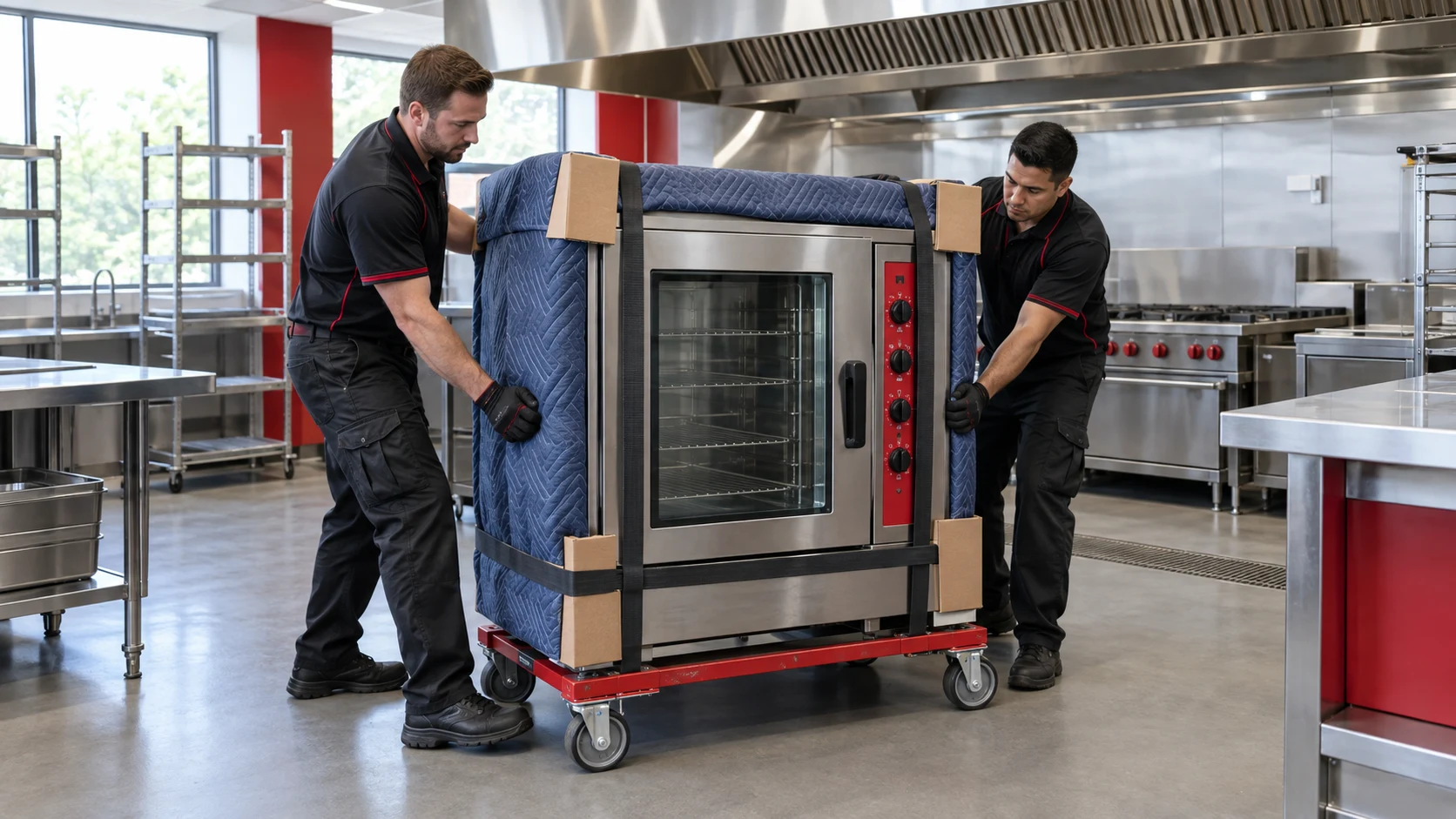
Protect stainless surfaces, corners, controls and doors from impact and rubbing. Handles and exposed pipes are not lifting points. Stone tops, counters, suspended décor and signage need separate review of removal, support and reinstatement. Any specialist work must have an agreed owner before loading begins.
Connect the move schedule to the reopening plan
Set the last customer service, food clearance, technician completion and loading window in that order. Earlier packing of non-essential items may help, but delivery does not establish readiness to reopen. Installation, cleaning, technical tests and the client's operational checks still need their own time.
Review rear entrances, goods lifts, stairs, thresholds and loading restrictions, especially in managed malls. Allocate receiving areas by kitchen station and dining zone. Do not block escape routes or the space technicians need to install equipment. Confirm who can approve a change if the destination is not ready.
Survey boundaries and physical delivery checks
The survey establishes equipment weights, access, packing and the handling method. Gas, electrical and plumbing work, hood installation, food transport and approval of operational or hygiene readiness are not automatic inclusions. Exceptional lifting is accepted only after the required route, resources and specialist input are assessed.
On receipt, check unit identifiers, loose parts, doors, glass and visible surfaces. Do not power equipment merely because it has arrived. Follow its technical release and manufacturer instructions. Keep the moving handover separate from installation and commissioning so each party's responsibility remains clear.
The four equipment classes, and how each one travels
A restaurant kitchen is not one kind of load; it is four, and each travels by its own rules. The survey classifies every item into one of them, because the class decides the packing, the handling, the vehicle position and the order of the day.
The cooking line
Ranges, fryers, grills, ovens and salamanders are heavy, greasy and full of fragile fittings behind their steel skins. They travel cleaned, drained and dried, racks and loose parts out and packed separately, knobs and thermostats protected, doors taped. Casters are never trusted on a ramp; equipment rolls on skates or carries, with weight low in the vehicle and strapped against the wall. A fryer that arrives with a cracked valve is a reopening date missed, so fittings get the ceremony the steel suggests they do not need.
Refrigeration
Fridges, freezers, display cases and ice machines are the sensitive class, and the next chapter gives them their due. Short version: emptied, defrosted, dried, upright always, compressors settled before power returns.
Preparation and warewashing
Mixers, slicers, food processors, dishwashers and glasswashers: mid-weight machines with blades, arms and pumps. Blades and moving parts come off and pack in labeled bags against the machine's line on the inventory; water lines drain fully, because a pump moved with water inside becomes a seized pump by arrival.
The front of house
Coffee machines, POS terminals, display refrigeration and the furniture of the dining room travel on household-moving discipline with commercial padding: espresso machines drained and boxed upright, screens in their proper cartons, tabletops blanket-wrapped and racked on edge. The front of house is what your guests see on reopening day, so it is packed to arrive ready to be seen, not ready to be repaired.
Refrigeration deserves its own chapter
Every refrigeration unit is a sealed circuit with oil in the wrong place the moment it tilts. That one fact drives the entire protocol, which is stricter than for any other equipment class and non-negotiable in both directions.
Before the move
Empty completely, and plan the kitchen's last days so stock runs down rather than transfers, because food in transit is a health problem, not a logistics one. Defrost fully, freezers and cold rooms first, since they take longest. Wash and dry every interior to the last corner; a damp seal grows what a health inspector finds. Doors are taped shut with protection under the tape, shelves and drawers out and packed separately, and gas or water lines to ice machines disconnected and capped.
During transport
Upright, always upright, strapped to the vehicle wall with padding at contact points. A unit laid on its side pulls compressor oil into the refrigerant lines, and the damage announces itself weeks later as a dead compressor and an invoice with no obvious cause. Where a unit must tilt for a doorway, it tilts the minimum, for the minimum time, and the wait before power-up grows accordingly.
After arrival
The unit stands in position, unpowered, until the oil has settled home: a few hours for an upright trip, a full day where the journey involved lying down or long tilting. We place, level and wait with you; power-up and temperature verification belong to your refrigeration technician, and the plan schedules their visit rather than hoping for it. A cold room or walk-in is its own conversation, panel by panel, and the survey says early whether your unit moves, or whether moving costs more than replacing, because sometimes honesty is a quote for a new one.
Gas, electricity and water: who disconnects what
The shortest chapter on this page, and the one with the sharpest edges: utility disconnection and reconnection belong to licensed technicians, not to movers, and any moving company that offers to pull your gas line as part of the package is telling you something about their standards.
Gas
Gas disconnection and reconnection require a certified gas technician, in many buildings arranged through the building or the utility. The plan schedules them first at the old site and first at the new one: disconnected and capped before we touch the equipment, reconnected and leak-tested before your kitchen relights. We coordinate timing so the technician's hour and our crew's hour never collide and never leave a day of dead equipment between them.
Electricity and water
High-load equipment wired to isolators, three-phase lines, hood interlocks: an electrician's scope. Dishwashers, ice machines and sinks: plumbed disconnection by your plumber or building maintenance. Small appliances on ordinary plugs are the one grey zone, and even there our rule is unplug and coil, never modify. The survey maps every connection point and names its owner, so the moving day has no standing around a machine nobody is authorized to touch.
What we do instead
Everything physical that follows: the cleaned, drained, certified-disconnected equipment is ours from that moment, packed, carried, transported, positioned and leveled at the new site, ready for the technicians' return visit. The sequence, technician out, movers through, technician in, is written into the same plan as the packing, because in a restaurant move the schedule is the service.
The reopening window is the real budget
A restaurant move is priced in two currencies: the quote, and the days of revenue lost between last service at the old address and first service at the new. The second is usually the larger, and it is the one the plan is built to shrink.
Night moves and dead days
The natural window is your weekly closing day plus the nights around it: last service Sunday evening, equipment out overnight, positioned Monday, technicians and fit-out finishing through the closed days, first service when the week restarts. For venues that close only one day, the move stages across several nights: dry stores and spare equipment first, the cooking line last. Every plan starts from your service calendar, not from our truck availability, because a mover who does not ask when you serve has not understood the job.
Staging keeps the kitchen alive
Most restaurants can run a reduced menu from a reduced kitchen. The plan exploits this honestly: duplicate and rarely-used equipment moves early; the core line moves in one tight window; and where the gap is unavoidable, we say how long it is rather than discover it with you. Pop-up or delivery-only operation from the new site, where licensing allows, can bridge the gap entirely, and the move sequence is arranged to make that possible: cold storage and one cooking station operational first.
The honest arithmetic
Sometimes the math surprises: an extra moving crew costs less than one lost Friday night. We put both numbers in front of you, the cost of speed and the cost of closure, and let them argue. That conversation, at the survey, is where most restaurant moves are actually won or lost, long before anyone lifts a fryer.
The new kitchen must be ready before the truck is
Restaurant equipment has the longest list of arrival conditions of anything we move. A fryer cannot wait in a corridor; a cold room cannot stand in a yard. The readiness check at the new site is therefore a formal step, completed before load-out, and it covers more than walls and a door.
What ready means
Ventilation first: the hood and extraction installed and commissioned, because cooking equipment positioned before its extraction exists must often be positioned twice. Fire suppression connected and certified where the system requires it. Gas and electrical points live at the positions on the kitchen plan, capacities confirmed against the equipment list. Floors finished and drains functional; a kitchen floor sealed after equipment lands is a floor sealed around obstacles. Water on, grease trap in place. And the unglamorous one: access measured, door widths, corridor turns, elevator capacity, against the largest single item, which is usually the cold room panels or the combi oven.
Coordination with your fit-out
Restaurant projects move against fit-out schedules, and the two must meet in one calendar, not two. We take the equipment position plan from your designer or consultant and sequence our delivery to the day the positions can receive: positioned once, connected, done. Where the fit-out slips, and fit-outs slip, the options are the honest trio: hold delivery, deliver to a staged area, or store with us until readiness, and the third usually beats the second because a staged kitchen is a workshop, not a kitchen.
Positioning is part of the move
When the room is ready, placement follows the kitchen plan to the centimeter: equipment rolled to its marks, leveled, aligned to its services, in the order the technicians need for connection, gas line first, refrigeration positioned early for its settling wait. A kitchen that is placed right the first time opens on schedule; that is the entire point of the chapter.
Smallwares: the thousand small things that reopen the restaurant
The equipment is the skeleton of a kitchen; the smallwares are its hands. Pots, pans, gastronorms, knives, utensils, crockery, glassware, cutlery, service ware, bar tools: thousands of items, none heavy, all essential, and collectively the most under-planned part of every restaurant move we have ever surveyed.
Count them before you pack them
Smallwares get the inventory treatment like everything else: counted by category, packed by category, labeled by category and station. The payoff arrives on reopening day, when the saute pans are in one carton marked saute station, not distributed across six cartons marked kitchen. Crockery and glassware pack in dish cartons with cell dividers, vertical, paper between every piece; cutlery nests by type in wrapped bundles; knives travel in rolls or guards, never loose, for the packer's hands and the unpacker's alike.
The honest cull
A move is the one moment a kitchen sees everything it owns at once, and the survey is the moment to use it: the chipped, the mismatched, the three broken thermometers and the pan with the loose handle are cheaper to replace than to wrap, carry and unwrap. We do not push the cull, but we note volume honestly, because you rent truck space and crew hours for everything that makes the trip, including the things that should not.
Perishables and consumables
Dry stores move sealed and labeled; chemicals move separately, upright, in their own clearly marked containers, never beside food or crockery; and anything opened, leaking or unlabeled is disposed of before the move, not discovered after. Perishables do not travel, as the refrigeration chapter says: the plan runs stock down to zero at the old site and the first delivery arrives at the new one, which is the only food-safe way to relocate a kitchen's larder.
The dining room: furniture, fixtures and the things guests touch
The dining room looks like the easy half and plans like the fiddly one. It holds more individual pieces than the kitchen, more finishes that scratch, and everything in it is on stage the moment you reopen. Its disciplines come from household moving, upgraded for commercial volume and a reopening deadline.
Furniture
Tables disassemble where they are designed to, tops wrapped in blankets and racked on edge, legs bagged and taped to their own top. Chairs stack by design only, and only with felt or card between every contact; chairs not designed to stack travel upright in rows, blanketed. Banquettes and fixed seating are a survey conversation: some move, some were built into the room and stay with it, and knowing which before the quote is the difference between a price and a surprise.
Fixtures, screens and sound
POS terminals, screens, sound systems and the tangle behind the bar photograph before they disconnect, cables labeled at both ends, the same discipline as a server room at smaller stakes. Light fittings and wall decor come down, wrap and crate as their fragility demands. The menu board, the neon, the framed reviews, the things that make the room yours, get the exceptional-items treatment, because they are the reopening photo.
Outdoor seating
Terraces and pavement seating move with their own checklist: parasols disassembled and sleeved, bases drained, planters emptied or replaced, anything fixed unscrewed against the landlord conversation. Outdoor furniture lives a harder life than indoor and fails at its joints; the survey notes which pieces are worth the trip, and the honest answer is sometimes that the terrace rebuys cheaper than it moves. Whatever the verdict, it is written down, agreed, and priced before the moving day, because moving day is not when a restaurant should be having furniture opinions.
The bar and the coffee machine: small size, high stakes
Two stations punch far above their weight in every restaurant and café move: the bar and the coffee point. Both combine water, pressure, heat, glass and daily revenue in a square meter, and both have their own protocols.
The espresso machine
The espresso machine is the single most relocation-sensitive object in a café, a boiler, pump and electronics in a brass suit. It travels drained of water, boilers emptied, portafilters and loose parts bagged, wrapped and boxed upright with cushioning all around, and it never rides under anything. Reinstallation, plumbing and pressure checks belong to its technician, ideally the supplier's, and the plan books them for the new site, because an espresso machine plumbed by optimism makes expensive fountains. Grinders travel empty of beans, burrs protected. The same rules cover batch brewers, hot water towers and juicers.
The bar
Bar refrigeration follows the refrigeration chapter, upright and settled. Glasswashers drain and dry like their kitchen cousins. Optics, taps and draught systems disconnect professionally; beer lines clean before the move or replace after it, and we say honestly which your system wants. Glassware packs by type in cell cartons, and the back-bar shelving photographs before it comes down so the new wall reassembles from evidence, not memory.
The till and the tech
POS, card terminals, printers and the Wi-Fi backbone pack in one labeled crate per station, photographed connected first, and the crate travels in the cab, not the hold. Your reopening depends on that crate more than on any appliance in the building; the plan treats it accordingly, first off the truck, first onto its counter, ready for the technician who reconnects it.
Dark kitchens, central production and franchise moves
Not every kitchen that moves serves guests from its address. Cloud kitchens, central production units, bakeries supplying branches and franchise operations all relocate by the same disciplines, with a few emphases of their own.
Dark kitchens and production units
A dark kitchen is all back of house: no dining room, no decor, pure equipment and throughput. Its move is the kitchen chapters of this page, undiluted, and its downtime is measured in missed delivery-platform slots, which concentrate revenue into fewer, more painful hours. The plan targets the platform calendar: move between peak days, restore the delivery menu first, and where several kitchens share one facility, coordinate the move with the operator's own schedule, because their freight elevator is your critical path.
Central production and bakeries
Bakery and central production equipment, deck ovens, proofers, sheeters, planetary mixers, is the heaviest class per item in this trade, and some of it is effectively installed plant. The survey distinguishes what unbolts and travels from what was built in place, and prices both honestly: rigging and floor protection for the heavy iron, panel-by-panel deconstruction for the built-in. Ovens cool fully before handling, proofers drain, and anything stone-hearth gets a specialist opinion before anyone promises it a ride.
Franchise and multi-branch
Franchise moves add one layer: standards. The brand's equipment list, layout rules and approved-supplier conditions shape the plan, and the survey reads them alongside the room. Where the move is one branch of several, inventory labeling names the branch on every carton, because in a franchise system, unlabeled equipment has a way of becoming someone else's equipment. One written plan, one point of contact, and the reopening date defended like the revenue it is, the same promise as always, just signed by more people.
Licensing and hygiene at the new address
A moved restaurant is, in the eyes of every authority, a new restaurant. Licenses, health registration and inspections attach to the address, not to the business, and the reopening date on your move plan is only real if the paperwork timeline agrees with it. This chapter is not legal advice; it is the scheduling honesty of movers who have watched reopening dates slip over a form.
Start the paper before the truck
Health and civil-defense requirements, signage permits, outdoor-seating licenses, the notifications your local authorities expect: start them when the new lease signs, not when the old kitchen closes. The survey asks about your paperwork timeline for one practical reason, our schedule hangs off your reopening date, and a reopening date that assumes instant licensing is a date we would rather challenge early than watch slide.
The hygiene handover
Both addresses have a hygiene dimension to the move. At the old site, the clean-out matters: grease, waste oil and food residues disposed of properly, the premises left to the standard your lease and your conscience require, because a bad exit follows a reputation. At the new site, the kitchen arrives into cleanliness or the equipment sits while cleaning happens, the plan books the deep clean before our delivery day, never on it. And through the move itself, food-contact surfaces travel wrapped, chemical and food zones never share a carton, and anything that touches what guests eat is handled as what it is.
What we will and will not promise
We schedule around your licensing reality and flag the risks we can see from experience. What we cannot do is make the paperwork faster, and any mover who says otherwise is selling comfort, not a date. Plan licensing and moving as one timeline, and the reopening date becomes a promise instead of a hope.
People and suppliers: the communication side of the move
A restaurant move fails loudly or quietly in proportion to its communication. The truck work takes a day or two; the people work runs for weeks, and the survey opens both at the same time.
Your team
The staff plan answers three questions early: who works through the gap, who takes the break, and who helps at the new site. Chefs know their kitchens better than any inventory, and one senior kitchen hand on the packing day, identifying what matters and what is junk, saves its wages several times over. Front-of-house staff can deep-clean and reset the new dining room while the kitchen lands. Everyone does better with a date, a plan and their role in it, so put all three on the staff board as soon as they exist.
Suppliers and deliveries
The supplier list needs the move date and the new address with a cutoff: last delivery to the old address on this day, first to the new on that one, nothing in between. Standing orders, linen, gas bottles, water, coffee, packaging, each gets the same instruction in writing, because a crate of produce delivered to a dark kitchen is money and goodwill spoiling together. The last weeks run ordering down, as the smallwares chapter says, so the cutoff lands softly.
Guests and the map
Announce early, announce everywhere: the sign on the old door, the booking platforms, the map listings, the social channels, each with the move date and the new address, then the reopening confirmation the day it happens. Regulars forgive a closed week; they do not forgive arriving at a shuttered door with no warning. The mover's part in this is small but real: we schedule so the announced date is the kept date, because a reopening pushed twice is a reopening some guests never hear about.
The mistakes that close restaurants for an extra week
Restaurant moves fail in predictable places. This list is collected from the repairs, delays and reopening pushes we have watched, and every item on it was cheap the day before it was expensive.
Moving dirty or wet
The first and worst: equipment moved greasy, fryers with oil in them, fridges with water in their seals. Grease migrates onto every surface it touches in the truck, water breeds what health inspectors find, and both turn a moving job into a remediation job. The clean-drain-dry chapter exists because this mistake is the most common and the most preventable.
The unmeasured door
Second place: the item that does not fit, the combi oven and the corridor turn, the cold-room panel and the elevator. Every large restaurant has one piece that defined its move, and the survey measures it against both buildings before anything else gets priced. A ramp, a removed door leaf, a winch through a window: solutions exist, but only for the team that measured.
Treating technicians as an afterthought
Third: booking movers but not the gas technician, the refrigeration tech or the espresso engineer, and discovering that equipment delivered on Monday cannot light until Friday. The sequence, technician out, movers, technician in, is the spine of the whole plan, and the survey books around it from the start.
The silent stock
Fourth: a storeroom of food nobody ran down, moved anyway, and condemned on arrival. Fifth, and quietest: no inventory, so the first week at the new site is spent hunting for the box that has the thing, while service limps. Both are avoided by the two cheapest tools on this page: a stock rundown plan and a labeled inventory. Ask us for both at the survey; they cost nothing and they are the difference between a move and a clean move.
More practical answers, briefly
Can you move us overnight? Yes; night and closed-day moves are the standard pattern, and the crew is scheduled around your service calendar. Do you move just the kitchen? Yes; kitchen-only, front-only and partial moves all quote cleanly. What about the walk-in cold room? Surveyed panel by panel; some move economically, some do not, and the survey says which before you spend anything. Do you work outside Cairo? Yes, across every Egyptian governorate, with routes planned for equipment loads. Are we insured? Equipment we pack travels under our full insurance frame, declared values on the inventory, the same honest terms as every service on this site.
Why restaurants move with MOVE ME EGYPT
Because we plan the reopening, not just the ride. Every chapter of this page is a promise we put in writing at the survey: the inventory, the sequence around your service calendar, the technicians' visits coordinated with ours, the equipment classes handled by their own rules, the readiness check before the truck rolls. Because our crews treat a combi oven differently from a sofa, and a POS crate differently from both. Because the quote is itemized and the boundaries are honest: licensed technicians for gas and commissioning, your stock run down by plan, no promises we cannot keep. MOVE ME EGYPT, the moving brand of INEX LOGISTIC, around the clock, every governorate, for the night your restaurant changes address and the morning it opens as if nothing happened.
Book the survey, keep the date
The next step is a survey at your restaurant, with whoever knows the kitchen best in the room, producing the written inventory, the sequence around your service calendar and the itemized quote. Call or message us any hour; the lines run around the clock. Bring your lease dates, your service days and your reopening ambition to that first conversation, and we will bring the plan that makes all three agree.
The week before: a short checklist for the owner
Seven days out, confirm the technicians' visits for both addresses and the utility dates at the new one; a kitchen without gas, power or water does not open, whatever the truck does. Confirm the licensing steps that attach to the new address rather than the move. Run the stock down toward the plan: order short, sell the specials, gift what will not travel. Freeze the menu that will reopen the restaurant, so every crate label can say where its contents belong. Photograph every cable and fitting behind every appliance, and file the photos with the inventory. Back up the POS and the recipes. Tell your team the timeline and their part in it. Two days out, drain, defrost and dry everything wet, and lock the crate count with the coordinator. The day before, walk both addresses against the plan one last time, then sleep: the crew has the sequence, and your job tomorrow is to watch it land.
Final notes before you hand us the keys
Keep the first week gentle: a soft opening with a short menu lets the kitchen find its feet in the new room and tells you what to adjust while the stakes are small. Keep every document from the move (inventory, quote, handover notes, technician certificates) in one folder; it is the story of the move and the answer to every later question. And keep the plan after reopening, because the second move is easier than the first when the first was documented. Most of all, keep your date: with the survey done, the sequence written and the technicians booked, the date you announced is the date you open.
How the equipment travels
Restaurant loads ride on their sides only when the manufacturer allows it; compressors travel upright or rest upright at destination for the hours the maker specifies before power returns. Racks bolt to the truck wall, casters lock, glass rides in crated A-frames, and nothing heavy rests on anything fragile regardless of direction. The route is planned for the load: low bridges, rough stretches and heat all matter more to a refrigerated prep line than to a sofa, so the shortest way is not always the chosen way. At the new address the sequence reverses in order, position by position from the floor plan, so the technicians walk into a room that is ready for them.
The honest insurance frame
Insurance on a restaurant move works like insurance on any move with us: equipment we pack and carry is covered under our full insurance frame, with declared values agreed at the survey and written on the inventory. Damage by third parties, technicians' work and pre-existing faults sit outside it, and we say so plainly rather than hide behind fine print. Bring your questions to the survey; clear terms are part of the plan.
Talk to us before you tell your guests
Announce the move after the survey, not before: once the sequence exists, your date becomes a promise you can keep. The conversation costs nothing and commits you to nothing.
The first week in the new room
Expect small adjustments: a shelf that belonged two steps left, a drain that runs slower, a hood that hums differently. Note them, fix the cheap ones immediately, and schedule the rest.
From any city to any city
The same plan travels everywhere we work: survey, sequence, pack, move, reopen. Distance changes the route, never the method.
Your date, kept
That is the whole service: your restaurant closed one evening and open the next, your date kept, your guests none the wiser.
What needs to be agreed
Refrigeration circuits, gas systems and technical commissioning are not automatically included. The client or its appointed specialists must prepare equipment for safe transport. The service is accepted only after the contents, handling needs and responsibilities have been reviewed.
Prepare these details
- Separate dining furniture from kitchen and fixed equipment.
- Provide dimensions, weights and equipment instructions where available.
- Arrange qualified isolation and disconnection before collection.
- Confirm food, chemicals, oils and waste are not left inside equipment.
How the move is planned
Share the inventory
Send the collection and delivery locations, preferred date and a clear inventory. Photos help us identify missing information, but they do not automatically replace a site survey.
Review access and the scope
We review entrances, stairs, lifts and loading points, then identify packing, dismantling, transport and any work requiring another specialist.
Agree the quote and responsibilities
Check the included and excluded work, stages, contacts and receiving arrangements. Changes to the inventory or address need review before they become part of the plan.
Prepare, move and hand over
The team follows the agreed scope, with labels and inventory checks at delivery. Record visible observations at handover and keep important personal items with you.
Locations and availability
We welcome moving requests from all of Greater Cairo: Nasr City, New Cairo, the Fifth Settlement, the New Administrative Capital, 6th of October City, Sheikh Zayed, Maadi, Zamalek, Katameya Heights, Katameya Golf and New Giza. Our service covers every governorate in Egypt: Alexandria, the North Coast, Ain Sokhna, Suez, Hurghada, Sharm El Sheikh, El Gouna and beyond. We have worked everywhere in Egypt, and our crew reaches any address with the same planning and commitment. Send your area on WhatsApp and we will confirm the details and timing right away.
Survey and pricing
A quote depends on the inventory, volume, item type, distance, access and agreed packing, handling and assembly. We review the details and survey needs before a final offer. The household calculator is a planning tool, not a binding quote; it does not price company, factory, server, safe or piano moves, or inventories with unknown-volume items. Ask for the exact inclusions and exclusions before agreeing the work.
Frequently asked questions
Does an enquiry confirm a booking?
No. The team must review the request and agree the scope, availability and quote before the move is confirmed.
Is every task included automatically?
No. Packing, dismantling, handling, storage and specialist work depend on the written scope. Check the exclusions as well as the price.
What if my inventory or address changes?
Tell us before the move. A change can affect access, timing, equipment and price, so it needs review before acceptance.