MOVE ME EGYPT SERVICES
Furniture dismantling and reassembly
Some furniture needs dismantling to pass through a doorway; some is unsuitable for repeated dismantling or follows specific manufacturer instructions. We review the construction, condition and required destination assembly before agreeing the work. Existing damage and missing fittings must be recorded, not assumed repairable on moving day.
We dismantle and reassemble everything: every piece in the home is taken apart and put back together, we pack and arrange clothes, dishes and china in numbered cartons, and we hang paintings and wall art in their places in the new home before the crew leaves.
Assess whether the furniture can be rebuilt
Materials, joints, panel condition and previous dismantling affect the decision. Glued, modified or weakened furniture should not be treated as a new flat-pack set. Send joint photographs, existing defects, missing parts and any assembly instructions before agreeing work.
Check the destination room, doorway, ceiling height and orientation of doors and drawers. Changing a layout, shortening parts or adapting a worktop is not ordinary reassembly. Electrical or plumbing disconnection of integrated fittings needs the appropriate specialist and is not presumed within furniture work.
Identify parts and inspect the result
Record component relationships before dismantling, then identify panels and fixings so similar pieces do not become mixed. Protect edges, glass and finishes. Missing parts, stripped fixings or damage should be discussed before proceeding, not concealed with an improvised repair.
After assembly, check movement of doors and drawers and the furniture's stability and position. Wall anchoring needs suitable wall assessment, awareness of concealed services and client agreement. Replacement materials, repairs and modifications require separate approval; there is no blanket promise that every old item can be rebuilt without limits.
When professional assembly earns its cost
Most people can assemble a chair. The honest question is where the line sits between a pleasant Saturday with an Allen key and a job that deserves a professional, and the line is less about difficulty than about consequences. A mistake in a small bookcase costs an afternoon; a mistake in a wall-anchored wardrobe over a bed, a staircase handrail or an office full of workstations costs more, and sometimes in ways that only show up months later as a wobble, a sag or worse.
Scale is the first signal. One flat-pack unit is a hobby; twenty after a move is a project. Professional assembly turns a week of evenings into a single visit, with two fitters, the right tools on the van and a routine that has done the same wardrobe model dozens of times. The price comparison that matters is not money against zero; it is money against your own hours, valued honestly.
Risk is the second signal. Tall units that need wall anchoring, anything glass-fronted, beds that children will climb, and furniture going into rental property where damage is a deposit conversation: these all argue for someone who anchors, levels and checks as a discipline rather than a hope. Professionals carry the anchors, the wall plugs for concrete and gypsum, and the habit of refusing to skip the fixing.
The third signal is reassembly after a move. Furniture that has been dismantled once arrives with its own history: holes already drilled, joints already stressed, instructions long gone. Reassembling well means reading the furniture itself, knowing which connections can be tightened again and which need reinforcement. That is a craft skill, and it is the everyday work of an assembly crew attached to a moving company, which is why the two services fit so naturally together.
Dismantling before a move: what comes apart and what stays whole
Every move poses the same furniture question in miniature: what should be dismantled, and what is better moved in one piece? The answer decides how the truck is loaded, how the staircases go, and how the first evening in the new home feels. Getting it right is a judgment the survey makes piece by piece, but the logic behind the judgment is easy to understand.
The rule of thumb runs on three tests. The doorway test: if a piece cannot pass the narrowest point on its route, door leaf, stair turn, elevator cabin, it comes apart. The strength test: if a piece's joints carry load only because gravity holds them, like bed frames and large tables, they travel safer dismantled than stressed in a moving truck. The value test: if a piece would cost more to repair than to reassemble, dismantling is cheap insurance.
Beds are the classic dismantle: headboards, frames and slats separate into flat, friendly parts that travel strapped and arrive unharmed. Wardrobes with sliding doors come down to carcass and doors; the doors travel wrapped vertically like glass. Large dining tables surrender their legs. Sofas mostly stay whole, their frames built for it, with only feet and cushions removed, unless a stairwell forces the issue.
What stays whole is whatever is stronger assembled than apart. Solid one-piece chests, antique pieces with glued joints that should never be disturbed, and anything whose dismantling would break a finish or a seal. Kitchen cabinets stay on their rails until the survey says otherwise. The survey photographs what comes apart, bags and labels every screw and bracket, and tapes the hardware bag to the piece it belongs to, because a wardrobe without its bolts is a very expensive shelf.
The dismantling decision is reversible at quote time and expensive at the truck door, which is why it belongs in the survey and the written plan. When the crew arrives already knowing what comes apart, the morning runs on rails, and the first evening ends with beds that are actually beds.
How a professional crew works: tools, hardware and method
The visible difference between a professional assembly and an ambitious afternoon is not speed; it is method. A crew arrives with a van stocked like a workshop, works in a fixed sequence, and leaves behind furniture that is square, level and quiet. Understanding the method helps you judge what you are paying for and what a good result looks like.
The toolkit is unglamorous and complete. Cordless drivers with torque settings that do not strip chipboard, a full set of bits including the uncommon ones furniture makers love, rubber mallets, levels in two lengths, stud finders, drill bits for every wall Cairo builds, and a stock of consumables: wall plugs, spare cam locks, dowels, felt pads and touch-up markers. The van also carries protection: blankets, floor runners and corner guards, because assembly happens in finished homes.
The sequence never varies, because the sequence is where errors are prevented. The work area is cleared and protected first. Parts are unpacked and laid out against the inventory, and any shortage or damage is reported before a single screw turns. Assembly runs from the structure outward: carcass, then fixings, then alignment, doors and drawers last, because doors can only be true when the box beneath them is true.
Alignment is the craft moment. Hinges adjust in three directions, drawer runners in two, and a good fitter chases gaps with a level and a patient hand until every reveal is even. Tall units are anchored to the wall before anyone calls them done; the anchor is not optional decoration, it is what keeps a loaded wardrobe from becoming a hazard in a house with children or earthquakes of the domestic kind.
The close is an inspection you are part of. Every door opens, every drawer runs, every shelf sits, and you walk the result with the fitter before the van leaves. Packaging is flattened and taken away, and the space is left as it was found, minus the boxes and plus the furniture. That is the whole product: not assembled pieces, but a room that is finished.
Flat-pack realities: first assembly versus reassembly
Flat-pack furniture is engineered around a single heroic assumption: it will be assembled once, by someone following the instructions, and never moved again. Real life disagrees. Understanding what changes between the first build and every later one explains most of what goes wrong with flat-pack in moves, and how to keep it going right.
The first assembly is the furniture's best day. Holes are crisp, cam locks bite into virgin board, dowels seat exactly once. Done well, with every fastener snug and every square checked, a flat-pack piece can serve for years. Done hastily, with a driver where a hand tool belonged and cam locks torqued past their grip, the damage is baked in before the piece carries anything.
Every dismantling after that spends a little of the material. Chipboard does not forgive repeated screws in the same hole; each cycle loosens the grip, and the joints loosen with it. Good reassembly compensates: dowels get wood glue where the design allows, worn holes are repaired with glued dowel fill, cam locks are replaced rather than forced, and anything that no longer tightens gets reinforced with a bracket where it will not show. This is the work that separates a wardrobe that survives its third move from one that dies in its second.
Instructions matter more than pride suggests. When the paper is gone, photographs from the dismantling become the manual, which is why a careful crew photographs connections as they come apart. Mixed hardware from several pieces in one bag is the classic self-inflicted wound; labelled bags per piece are the cheap cure.
There is also a verdict moment, and honesty serves better than optimism here: some flat-pack reaches the end of its movable life. Joints swollen by a past leak, edges crumbling at the screw lines, backs nailed past removal. A professional says so at the survey, prices the realistic options, and lets you decide whether the piece moves, moves with reinforcement, or makes way for its successor.
Wardrobes and wall units
Wardrobes are the heaviest flat-pack most homes own, and the piece where assembly quality shows longest. A wardrobe is a box that must be perfectly square before anything else about it can be right: doors that meet evenly, drawers that run true and a back that stays flat all depend on the carcass being square first. Professional assembly starts with the diagonal measurement and the level, not with the doors.
Height changes everything. A two-metre unit is furniture; a unit reaching toward the ceiling is a structure, and it must be anchored. Wall anchoring is not a courtesy option on tall units: a loaded wardrobe holds hundreds of kilograms high off the floor, and the fixing to the wall is what keeps that weight where it belongs. The crew chooses anchors for the actual wall, concrete, brick or gypsum board, and the anchor points are checked for pull, not just pushed in.
Sliding doors deserve their own mention because they concentrate the complaints. A sliding door runs well only when the carcass is square, the floor is accounted for and the tracks are level to each other; on an uneven floor the unit is levelled with shims first, then the doors are adjusted to the corrected box. Hinged doors are more forgiving but still reveal a twisted carcass within a week, as a gap that grows.
Interior fittings go in last and are set for the people who will use them. Shelf heights, rail positions and drawer units are placed to your instruction, and this is the moment to say how the wardrobe will actually be used, long dresses, folded stacks, shoe rows, because moving a shelf pin later is easy, but deciding well once is easier.
The finish test is the quiet one: stand the doors closed and look along the line. Even reveals, no rocking, doors that stay where they are left. That line is the signature of the whole job, and it is what a fitter checks before asking you to look.
Beds, bunk beds and the safety checks that matter
A bed is the one piece of furniture that carries people, at height sometimes, and for a third of every day. Its assembly is therefore a safety job before it is a convenience job, and the checks that close the work are not formalities: they are the difference between a bed that is quiet for years and one that announces itself every time someone turns over.
Frames live and die by their corner joints. Every connection is seated fully before it is tightened, tightening runs across opposite corners in sequence so the frame pulls up square, and the fasteners are torqued to firm, not to maximum, because crushed threads in wood or chipboard hold nothing. A frame tightened in a circle, one side fully before the next, racks itself out of square and creaks forever as a reminder.
Slats and bases get the attention the mattress will not give them. Slats seat in their holders at both ends, centre rails touch the floor on their feet, and the base lies flat with no rocking before the mattress arrives. A bed that rocks on day one will squeak on day thirty, and the fix is always the same: find the high corner, adjust, retighten.
Bunk beds and high sleepers add the rules that protect children specifically. Guardrails on both sides of the upper bunk, ladder fixings checked for pull, every bolt of the upper structure tightened and then tightened again after the first week of use, and a strict eye on the manufacturer's weight and age limits. Anchoring to the wall where the design provides for it is done, not discussed. These are not places where assembly gets creative.
The handover check is physical: the fitter loads the bed, pushes at the corners, pulls at the rails, and invites you to do the same. A bed that passes a deliberate shake in the showroom of your bedroom passes the years. Anything that moves gets found today, while the tools are still out.
Office furniture: workstations, desks and meeting rooms
Office furniture assembly is a different sport from home work, because the unit is not a desk but a floor of desks, and the clock is not a weekend but a business that opens Monday. The priorities shift accordingly: consistency across dozens of identical units, cable discipline from the start, and a sequence that lets the fitters finish a row while the network team works the next one.
Workstation systems arrive as components, legs, beams, tops, screens, pedestals, and assemble into benches whose straightness multiplies with every station. The first bench of a row sets the line for all the rest, so it is levelled with extra care, and each following station is referenced to it rather than to the floor, which is never as flat as it looks. Height-adjustable desks add their motors and control boxes, each tested through its full travel before the top is declared done.
Cable management is decided at assembly, not after it. Trays, spines and grommets belong to the structure, and a desk built without them is a desk that will wear its cables like ivy. The crew routes power and data paths as the desks are built, leaves service loops where the plan calls for them, and keeps the underside clean enough that the IT team thanks rather than curses.
Meeting and conference pieces carry their own weight, literally: boardroom tops are heavy, their bases must be levelled before the tops land, and modular conference tables are aligned section to section so the surface reads as one plane. Storage walls and shelving systems follow the tall-unit rules: square carcass, anchored to wall or floor, levelling before loading.
The working pattern for a full floor is logistics as much as joinery: staged deliveries matched to assembly sequence, packaging removed continuously so floors stay walkable, and a day-end report of stations complete, stations pending and anything waiting on parts. Monday morning readiness is the product, and it is built from Saturday morning onward, station by station.
Kitchen units and fitted storage
A fitted kitchen is the most demanding assembly in the house, because it is not one piece but a wall of pieces that must agree with each other and with a room that is never square. Floors slope, walls wander, and pipes appear where drawings forgot them. The fitter's job is to make a straight kitchen in a crooked room, and the order of operations is what makes that possible.
Everything hangs on the first line. Wall units mount to a level line drawn once, high, and checked twice; base units are levelled to a second line that accounts for the floor's worst slope. The two lines decide every door gap and worktop joint that follows, which is why a fitter spends the first hour with a level and a pencil rather than a drill.
Carcasses join to each other before they join the wall. Units clamp together, faces flush, connecting bolts pulled up, and only then does the run fix to the wall at every stud or anchor point. Doors and drawer fronts hang last and adjust after the full run is loaded, because a front aligned on an empty cabinet shifts the day the dinner service moves in.
Worktops are their own craft. Cuts meet at sealed joints, overhangs are supported, and the top is fixed from below so no fastener shows. Where a sink or hob cuts the top, the cut edge is sealed against the water that will find it for the next twenty years. These are the small unglamorous steps that decide whether a kitchen still looks new at its fifth birthday.
Fitted storage elsewhere in the home follows the same discipline at smaller scale: utility rooms, hallway benches, under-stair units. Level first line, joined carcasses, fronts adjusted under load, every tall element anchored. A fitted unit done well disappears into the house, which is exactly the compliment it is built for.
How assembly work is priced
Assembly pricing follows the work, not the mystery. Three things decide a fair quote: how many pieces, what kind of pieces, and what condition they arrive in. A home visit or a good list with photos turns those three into a fixed price, and a fixed price is what you should expect before a date is set.
Piece count is the base. Each item carries a normal time: a dining chair is minutes, a sliding-door wardrobe is hours, a fitted kitchen is days. Kind matters beside count, because some pieces are slow by nature, wall units with anchoring, height-adjustable desks with motors, anything with glass, and the quote that lists pieces by name is the quote that cannot surprise you later.
Condition is the honest third factor. New-in-box assembly is predictable; reassembly after a move carries the variables of worn holes and missing instructions, and a straight quote either prices a small contingency or says plainly what extra time costs if the surprises arrive. Neither is a red flag; silence about the possibility is.
What a quote should include, written down: the labour for assembly, the fixings and anchors for the walls you have, levelling and adjustment, wall anchoring of tall units, removal of packaging, and the final walkthrough. What legitimately sits outside it: repairs to furniture already damaged, custom carpentry, and wall or floor repairs, each quotable separately when wanted.
Two buying habits keep the price honest. Ask for the piece list in the quote, item by item, and ask what happens if a piece turns out unbuildable from missing parts: the professional answer is that the piece comes off the price, not onto it. Assembly is one of the trades where a written quote protects both sides equally, which is why the good ones insist on it.
The assembly mistakes everyone makes once
Furniture assembly has a greatest-hits album of mistakes, and almost everyone has played at least one track. They are listed here without judgement, because each is a natural wrong turn, and because knowing them in advance is the cheapest way to never learn them personally.
The backwards panel opens the album. Every flat-pack has panels whose front and back differ by a drilled edge or a finished face, and every instructions booklet shows the difference in a drawing nobody reads closely enough. The panel discovers its error at step fourteen of sixteen, when the back will not fit, and the correction costs the full disassembly. The professional habit that prevents it costs ten seconds: lay every panel out, finished faces down, before the first screw.
The overtightened cam lock is the quiet destroyer. Cam locks hold by friction in a drilled pocket, and a quarter turn past snug crushes the pocket while feeling satisfyingly tight. The joint fails weeks later, mysteriously. Torque discipline, firm, then stop, is the single skill that separates assembly that lasts from assembly that loosens.
The missing washer, the swapped bolt and the leftover screw form the chorus. Hardware counts exist for a reason, and a leftover fastener is not a bonus; it is a question. Equally classic is the wall anchor installed in the wrong wall: the plug that holds fifty kilograms in concrete holds nothing in gypsum board, and the fix is knowing the wall before drilling it, which is why a fitter taps and probes before choosing the anchor.
The final track is impatience with alignment. Doors forced to close by leaning on them, drawers run with a hip check, gaps accepted because evening came. Alignment is ten minutes of small adjustments with a level and a hinge key, and it is the entire difference between furniture that looks built-in and furniture that looks forgiven.
Children's furniture: assembly with a safety margin
Furniture for children's rooms carries the strictest audience in the house: users who climb, hang, jump and test every joint daily, without reading weight limits first. Assembly for this audience adds a safety margin to everything, and the margin is built from specific choices rather than general carefulness.
Anchoring comes first and is not negotiable. Every tall piece in a child's room, wardrobe, chest of drawers, bookcase, fixes to the wall, because the statistics on tipping furniture are written in climbing children. The anchor matches the wall, the fixing is tested by pulling, and the test is repeated harder than a child can. Drawer stops stay in place; a drawer that pulls fully out is a ladder rung and a falling hazard in one.
Bunk beds and loft beds follow their manufacturer's limits to the letter, as the beds section describes, with the addition that matters most in real rooms: placement. The upper bunk keeps clear of ceiling fans and light fittings, the ladder faces the room rather than the wall, and the route from bed to door in the dark is thought through once, with the child watching, before the first night.
Small parts and finishes get a second look. Caps cover every exposed bolt end, sharp shelf corners get guards at toddler height, and any touch-up after assembly uses child-safe products, since the finish on a cot rail is, realistically, a teething surface. Toy boxes with lids get soft-close stays or no lid at all; a falling lid and small fingers are a combination older than furniture.
The last check belongs to the parents, and a good fitter invites it explicitly: climb, hang and shake, within reason, before the room is declared finished. Children will conduct this audit themselves within the hour; better to run it first with tools in hand.
Outdoor and garden furniture
Outdoor furniture lives a harder life than anything indoors: sun that bakes plastics brittle, rain that finds every unprotected screw, and dust that grinds in every moving part. Assembly for the outdoors is therefore mostly a matter of choosing fasteners and finishes that survive exposure, and of placing pieces so the weather works on them as little as possible.
The fastener rule is absolute: nothing plain-steel goes outside. Stainless or galvanised hardware costs a little more and outlasts the furniture it joins; the standard screws shipped with many outdoor sets are the first thing to rust, stain and seize, and replacing them at assembly is cheaper than cutting them out later. Where the set allows, a drop of anti-seize or grease on each thread makes the first future disassembly possible at all.
Frames go together square and fully tightened, then get a second pass after a week of settling, because outdoor joints loosen faster than indoor ones under temperature swings. Wooden sets get their feet off wet ground on pads or adjustable glides, and any cut or drilled face is sealed before it meets the weather. Rattan and woven pieces are assembled gently; their fibres tolerate tension badly and forgiveness not at all.
Umbrellas, awnings and anything that catches wind are anchoring problems first and furniture second. Bases are filled or bolted to their rated weight, parasols close when unattended, and wall-mounted shades fix into structure, not cladding. Wind does not negotiate, and the cheapest insurance in the garden is a base that matches the canopy.
The placement conversation closes the job: which pieces live in full sun, which under cover, and what gets stored or covered for the season. Ten minutes of that planning at assembly day saves the furniture years, which is the whole point of having it assembled properly in the first place.
Reassembly after storage
Furniture coming out of storage is furniture with a past, and reassembling it well starts with reading that past honestly. Months in a unit change things: wood adjusts to a new humidity, metal hardware oxidises a little, and the careful labelling of moving day has had time to peel. The reassembly that respects this runs a short triage before the first bolt turns.
The triage is three questions per piece. First: did it come apart and travel complete? Hardware bags are opened and counted against the photograph from dismantling day; anything missing is sourced before assembly, not improvised during it. Second: has the material moved? Panels are checked for warp and swelling, joints for looseness gained in storage, because a panel that bowed in a humid unit needs gentle correction, not force, to sit square again.
Third: what needs refreshment? Wood glue in old joints is cleaned out and renewed, cam locks that have lost their bite are replaced, felt pads and glides are renewed as a matter of course, and wooden surfaces get their first cleaning and oiling before the piece goes back into service. None of this is major work; all of it is the difference between furniture that returns from storage and furniture that merely survives it.
The reassembly itself then follows the normal professional sequence, carcass, squareness, alignment, anchoring, with one addition: patience with pieces that need to re-acclimatise. Solid wood especially may need days in its new room before final door and drawer adjustment, and a good crew says so, schedules the follow-up, and leaves the furniture stable and usable in the meantime.
The reward for the extra care is simple: stored furniture that comes back is worth keeping, which was the entire argument for storing it. Reassembly is where that argument is finally paid out.
After the assembly: adjustments, warranty and care
The day the tools leave is not quite the end of the story. Newly assembled furniture settles into its home the way new shoes settle onto feet: a little movement in the first weeks is normal, and a small amount of aftercare turns a good assembly into a permanent one. Knowing what is normal, what is covered and what you can do yourself keeps small things small.
Settling is normal and expected. Timber and board respond to a new room's temperature and humidity, joints seat under load, and the first weeks may bring a door that needs a hinge touched or a bolt that wants a quarter turn. This is not failure; it is furniture finding its final shape. The habit worth keeping is a quick check after the first fortnight: a pass over visible bolts with the key left in the drawer, and a look at the door lines.
Professional assembly carries a workmanship warranty, and it should be named in plain terms: if something we assembled loosens, misaligns or fails in normal use within the warranty period, we come back and put it right. The warranty covers the work, not the furniture's own defects, a split panel from the factory is the manufacturer's conversation, but the fitter's report of what was found at assembly time, photographs included, is exactly the evidence that conversation needs.
Care is the third leg, and it is short. Keep tall furniture anchored and do not remove the fixings when rearranging rooms. Tighten before you force: a sticky drawer is a loose runner asking for a quarter turn, not a stronger pull. And keep water where it belongs; the fastest way to age flat-pack is a damp cloth left lying on an edge.
The point of all three is the same: assembled furniture should be boring for a decade. When it is not, the warranty is a phone call, the adjustment is minutes, and the alternative, living with the wobble, is the only option that was never on the table.
Questions to ask an assembly service
An assembly service is an easy purchase to make well, because the whole trade is visible: the furniture either stands square and quiet or it does not. A short list of questions, asked before booking, separates the services that deliver that result from the ones that deliver apologies.
First: is the price fixed, and what exactly does it include? Look for a quote that lists your pieces by name, includes fixings, anchoring, levelling and packaging removal, and states what happens if a piece cannot be completed from missing parts. Second: who is coming? A named crew with a track record beats an anonymous subcontractor; ask whether the people arriving are employees and whether they have built your brand of furniture before.
Third: how do you handle my walls and floors? The answer should mention protection, blankets, runners, corner guards, and anchors chosen for your wall type, concrete, brick or gypsum board, because a service that asks about your walls before arrival is a service that will not learn about them through your deposit. Fourth: what happens with tall furniture? The only right answer includes anchoring to the wall, tested, without charging extra for safety.
Fifth: what does your warranty cover, and for how long? Workmanship warranties are standard in the trade; their absence is information. Sixth: what do you do with the packaging? Removal should be included, because a room full of flat cardboard is half a job. Seventh: when can you come, and how long will it take? A realistic duration per piece list is a mark of a service that has done the work before.
The thread through all seven: a professional assembly service answers in specifics, in writing, without sighing. Furniture assembly is one of the few trades where everything the customer needs to know can be confirmed before the van arrives, which makes asking the cheapest step in the whole job.
Living room pieces and media walls
The living room is where furniture assembly meets the house's wiring, and the combination rewards planning. Media walls, TV units and shelving systems are built around a screen and its cables, which means the assembly sequence has to respect both: the furniture goes together first, the anchoring and levelling happen before anything is hung, and the screen is the last element to arrive, not the first.
TV mounting is the moment where mistakes are expensive and visible. The bracket matches the screen's size and weight rating, the fixings match the wall, and on anything but solid masonry the mount goes into structure, studs or a proper cavity system, never into plasterboard alone. Height is set for the seated eye, not the standing one, and the final tilt is adjusted after the cables are dressed, because cables pull.
Cable dressing is the difference between a media wall and a cable garden. Raceways or in-wall routes are planned before the unit is anchored, power and signal run separated where they can, and every connection gets a service loop so the unit can breathe for maintenance. The goal is a wall where nothing shows but the screen and the shelves, and everything behind it can still be reached.
Shelving systems carry their own discipline: uprights levelled and fixed top and bottom, shelves loaded from heavy at the bottom to light at the top, and any unit above shoulder height anchored like a wardrobe. Glass shelves get their suction-cup treatment and their pads, and the level check comes after loading, because shelves lie under weight in ways they never do empty.
The living room test is the sofa test: sit where the room is used, look at the lines, the screen height, the cable invisibility and the door swings. A media wall that passes the sofa test passes every other audience the house can offer.
Tables, chairs and the quiet test
Dining furniture looks like the easy end of assembly and is, until the first wobble. Tables and chairs live by their legs, and legs live by two things: joints tightened in the right order, and contact with a floor that is never perfectly flat. The professional approach to both is simple and repeatable.
Chairs assemble upside down on a protected surface, joints seated before any fastener turns, and the fasteners tightened across diagonals in small increments, the way a wheel's bolts are tightened, so the frame pulls together square instead of twisted. The glue blocks and corner braces that flat-pack chairs include are not decoration; fitted and tightened, they are what separates a chair that stays silent from one that starts conversations.
Tables follow the same logic at bigger scale. Legs and aprons join loosely first, the top goes on, and only with the table standing upright on the actual floor does the final tightening happen, in diagonal order, so the frame settles against gravity rather than against the assembler's idea of flat. Extension tables add their own check: the leaves run in and out several times before the job is done, because a rail that binds empty will jam loaded with a Sunday lunch.
The quiet test closes every table and chair job. Each piece is pressed, rocked and sat upon, on the real floor, in the spot it will live. A leg that hovers gets an adjustable glide, not a folded coaster; glides also protect the floor and silence the scrape that dining chairs produce in their hundreds per week. The result is furniture you stop noticing, which is the highest compliment a dining set can earn.
It is a small craft and an old one, and it is exactly the kind of work a professional crew does in an hour and a half where an ambitious Saturday loses a weekend. Either way, the standard is the same: nothing rocks, nothing creaks, and nobody at the table ever thinks about the table.
Assembly and your warranty
One more argument for professional assembly is printed in the small type: many furniture makers condition their warranty on correct assembly. A frame racked by out-of-order tightening or a mechanism forced into misalignment is an assembly fault, not a manufacturing one, and claims on it go nowhere. A professional crew assembles by the book, keeps the hardware count honest and the sequence right, and leaves you the instructions and the receipt. If anything is ever claimed, the furniture stands exactly as its maker intended, which is the only position a warranty recognizes.
The same care protects the floor, the walls and the deposit in a rented home. Levelling glides instead of dragging, anchoring into structure instead of guessing, and packaging hauled away instead of stuffed down the stairs: the marks that never happen are the cheapest part of the job, and the ones a moving-out inspection thanks you for.
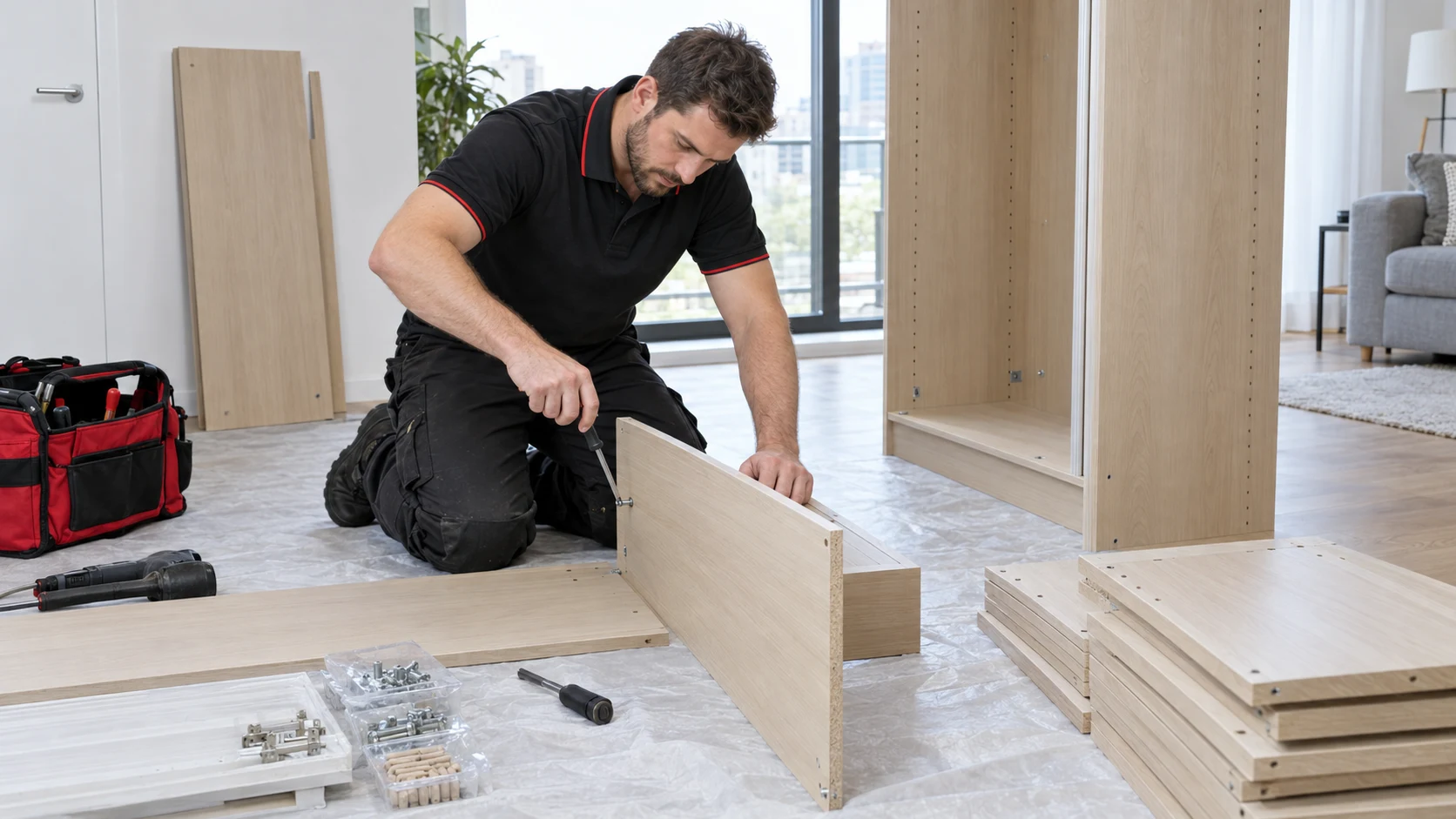
What needs to be agreed
Fixed kitchens, stone worktops, appliance connections and modification carpentry may need separate specialists. Replacement fittings or repairs are not included simply because an item is being reassembled. If the condition changes the workable method, it must be discussed before continuing.
Prepare these details
- Photograph complete pieces and their fixing points.
- Share assembly instructions or model details if available.
- Identify weak panels, old repairs and missing parts.
- Confirm the final position and available space for each piece.
How the move is planned
Share the inventory
Send the collection and delivery locations, preferred date and a clear inventory. Photos help us identify missing information, but they do not automatically replace a site survey.
Review access and the scope
We review entrances, stairs, lifts and loading points, then identify packing, dismantling, transport and any work requiring another specialist.
Agree the quote and responsibilities
Check the included and excluded work, stages, contacts and receiving arrangements. Changes to the inventory or address need review before they become part of the plan.
Prepare, move and hand over
The team follows the agreed scope, with labels and inventory checks at delivery. Record visible observations at handover and keep important personal items with you.
Locations and availability
We welcome moving requests from all of Greater Cairo: Nasr City, New Cairo, the Fifth Settlement, the New Administrative Capital, 6th of October City, Sheikh Zayed, Maadi, Zamalek, Katameya Heights, Katameya Golf and New Giza. Our service covers every governorate in Egypt: Alexandria, the North Coast, Ain Sokhna, Suez, Hurghada, Sharm El Sheikh, El Gouna and beyond. We have worked everywhere in Egypt, and our crew reaches any address with the same planning and commitment. Send your area on WhatsApp and we will confirm the details and timing right away.
Survey and pricing
A quote depends on the inventory, volume, item type, distance, access and agreed packing, handling and assembly. We review the details and survey needs before a final offer. The household calculator is a planning tool, not a binding quote; it does not price company, factory, server, safe or piano moves, or inventories with unknown-volume items. Ask for the exact inclusions and exclusions before agreeing the work.
Frequently asked questions
Does an enquiry confirm a booking?
No. The team must review the request and agree the scope, availability and quote before the move is confirmed.
Is every task included automatically?
No. Packing, dismantling, handling, storage and specialist work depend on the written scope. Check the exclusions as well as the price.
What if my inventory or address changes?
Tell us before the move. A change can affect access, timing, equipment and price, so it needs review before acceptance.